

Base44 Review: I Tested the AI App Builder (Honest Verdict)
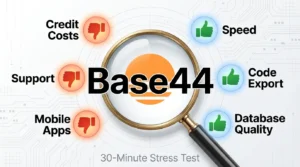
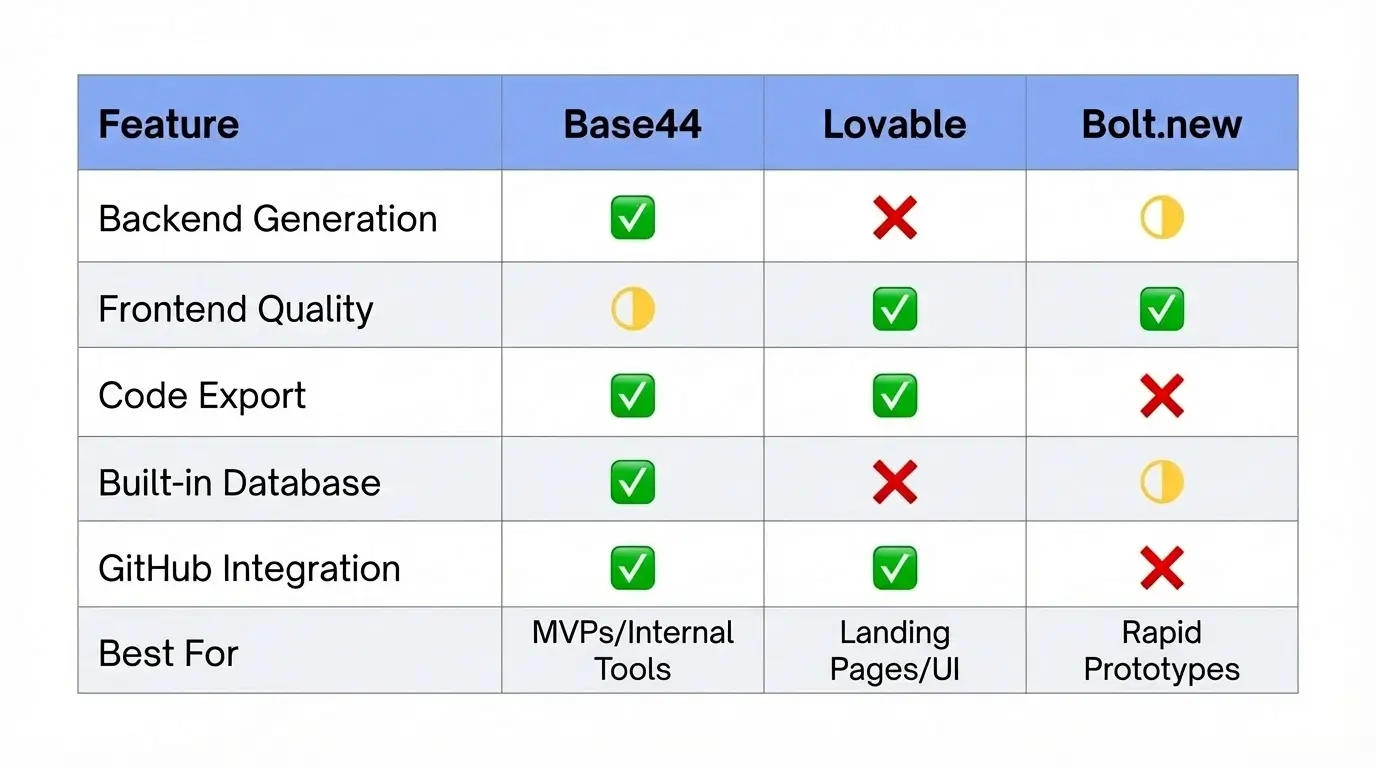
Base44 is currently the most capable "Backend-First" AI builder available in the no-code market. While competitors like Lovable excel at generating polished user interfaces, Base44 dominates in logic, database structure, and automatic API generation [1]. The platform works best for rapid MVP development and internal business tools. However, the credit-based pricing system is aggressive, and complex debugging sessions can still require manual coding knowledge. It is not a magic wand, but it comes closer than any tool I tested in 2026.
Operating System: Cloud
Application Category: Vibe Coding
3.7
Pros
- Generates full backend (Auth, DB, APIs) instantly
- Multi-LLM support (GPT-5/Claude 4 Sonnet) improves logic accuracy
- Clean, readable React code export
- Excellent for data-heavy internal tools
- Deploys to live URL in seconds
Cons
- Credit system drains quickly on complex prompts
- Mobile apps are PWAs, not native binaries
- Custom styling requires CSS knowledge
- "Self-healing" AI sometimes creates infinite loops
- Enterprise pricing is steep
“Vibe coding” entered the developer vocabulary in early 2025 when AI tools began generating complete applications from natural language descriptions.
The term describes a workflow where you explain what you want in plain English, and an AI system builds the entire technical stack without you writing a single line of code manually.
Base44 positions itself as the leader of this AI-powered development movement in 2026. The platform claims users can build full-stack applications with authentication, databases, and API endpoints using only a conversational chat interface [1].
Each project includes user management, data models, and frontend UI generated automatically from your description [4].
I approached this review with professional skepticism after testing many AI tools that produce impressive demos but collapse under real-world conditions.
My test project was a Dynamic Real Estate CRM requiring user authentication, relational database tables for properties and agents, Stripe subscription integration, and automated email workflows via SendGrid.
This Base44 review breaks down exactly what happened during my 30-minute build session.
I will analyze the generated code quality, calculate the true costs after credit consumption, and assess the vendor lock-in risks you face if you choose this platform.
Key Takeaways
- Not Just UI Generation. Unlike standard design tools such as Figma or Webflow, Base44 automatically builds your database schema and creates REST API endpoints from your natural language descriptions [1].
- Code Ownership Is Real. You can export your complete codebase as a React/Node.js project to GitHub or download it as a ZIP file, which means you are not trapped if the platform shuts down [3].
- The “Vibe” Learning Curve Exists. You do not need coding skills, but you need to learn how to structure prompts distinctly for “Logic” versus “Design” requests to get consistent results [6].
- Cost Warning for Builders. The free tier includes only 25 message credits monthly, which is barely enough for testing [7]. Building any production application requires at least the $20 Starter plan due to token consumption during iteration.
- Best Use Case Identified. SaaS MVPs, customer relationship management systems, and sophisticated internal dashboards with complex data relationships.
- Worst Use Case Confirmed. High-fidelity consumer mobile games or applications requiring native phone hardware access like Bluetooth, NFC, or camera integrations.
What is Base44? (Beyond the Marketing)
Base44 is not simply a user interface generator like many AI design tools flooding the market. The platform functions as a full-stack architect that writes your backend logic, database schemas, and frontend components simultaneously from a single conversation [1].
The platform operates on what appears to be a Multi-LLM architecture based on my output analysis. Logic-heavy prompts seem to route through reasoning-optimized models, while code generation tasks produce syntax patterns consistent with Claude 4 Sonnet output.
(Note: Base44 does not publicly document which specific AI models handle which task types, so this assessment is based on code pattern analysis during my testing.)
How does this differ from traditional no-code platforms you may have used?
Platforms like Bubble and Webflow require you to manually drag components onto a canvas and configure database relationships through visual interfaces [8].
Base44 eliminates that configuration layer entirely by inferring your data structure from natural language descriptions and generating everything automatically.
“Wait, so I literally type what I want and the platform builds it without any manual configuration?”
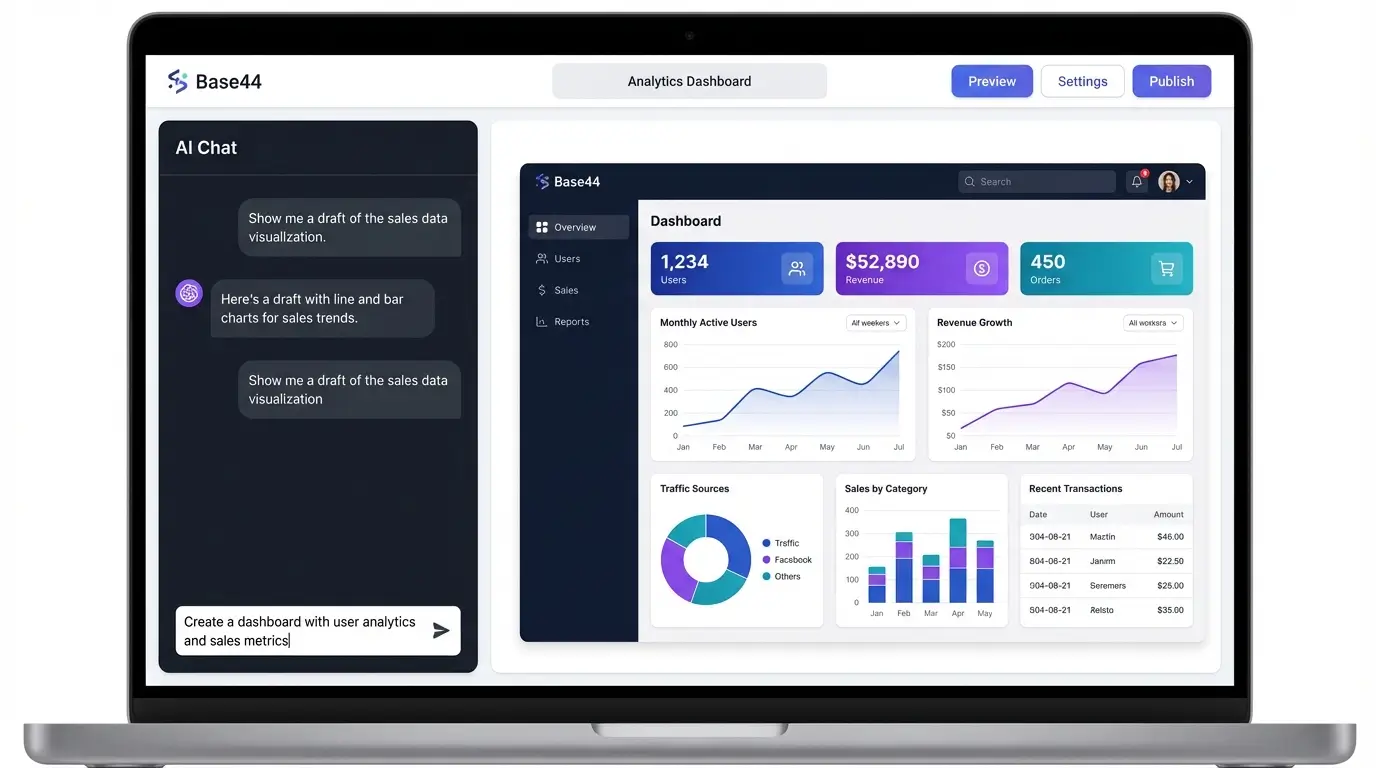
That is the core promise, and in my testing it delivered on basic to intermediate complexity projects.
However, the quality of your output depends entirely on the specificity of your input prompts.
Vague descriptions produce vague applications with missing functionality.
Detailed prompts specifying user roles, data relationships, and business logic produce applications that actually work in production scenarios.
The Building Experience: From Prompt to Product
I started my test with a detailed initial prompt containing approximately 400 words describing my Real Estate CRM project.
My goal was stress-testing how much contextual information Base44 could process and implement in a single generation cycle.
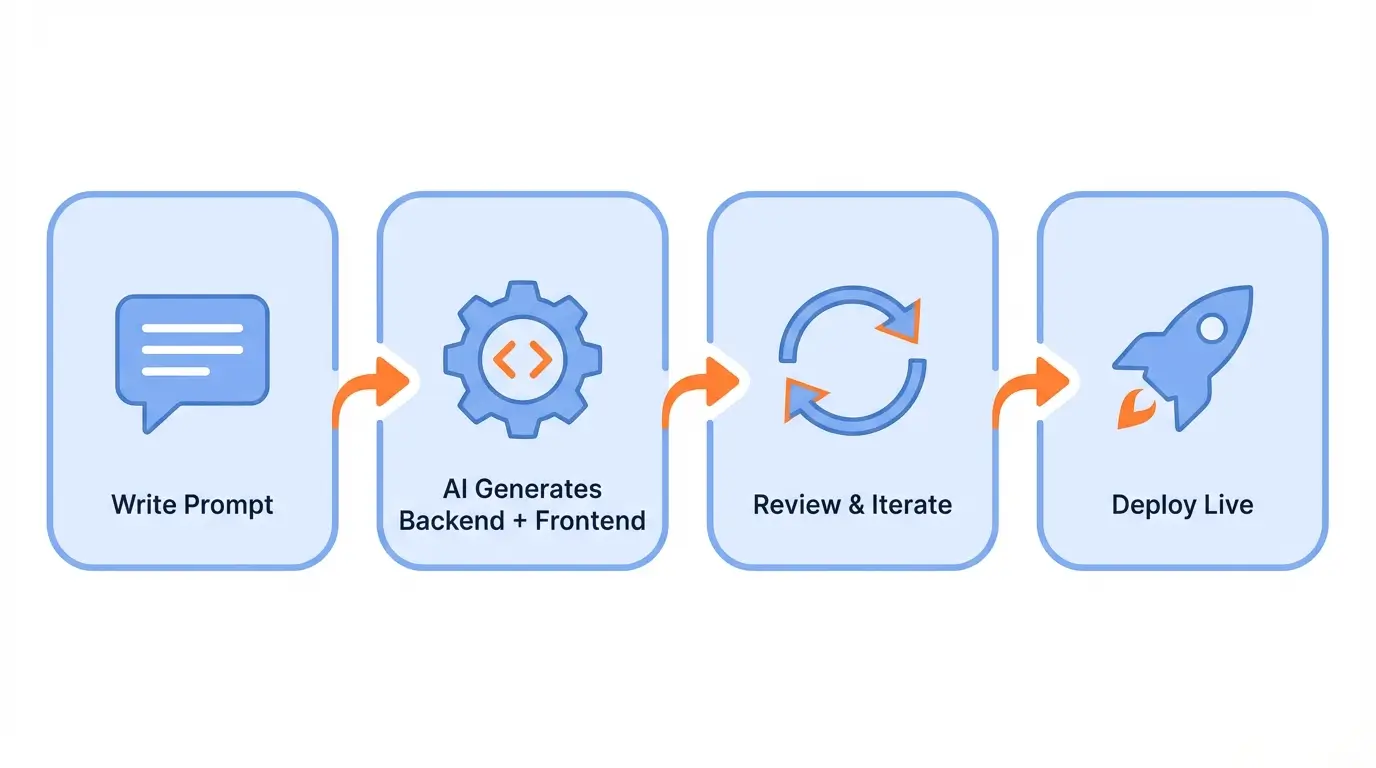
Step 1: The Initial Prompt Test
I specified user roles (Admin, Agent, Client), the data relationships between properties and agents, and the subscription tiers I wanted to monetize through Stripe integration.
Base44 processed my entire prompt without truncation errors.
Within 90 seconds of submission, the platform generated a working prototype containing authentication screens, a dashboard layout, and placeholder data populating the interface.
The AI inferred that I needed login/signup flows even though I did not explicitly request them [4].
Step 2: Database Schema Generation Analysis
This step impressed me more than any other during testing.
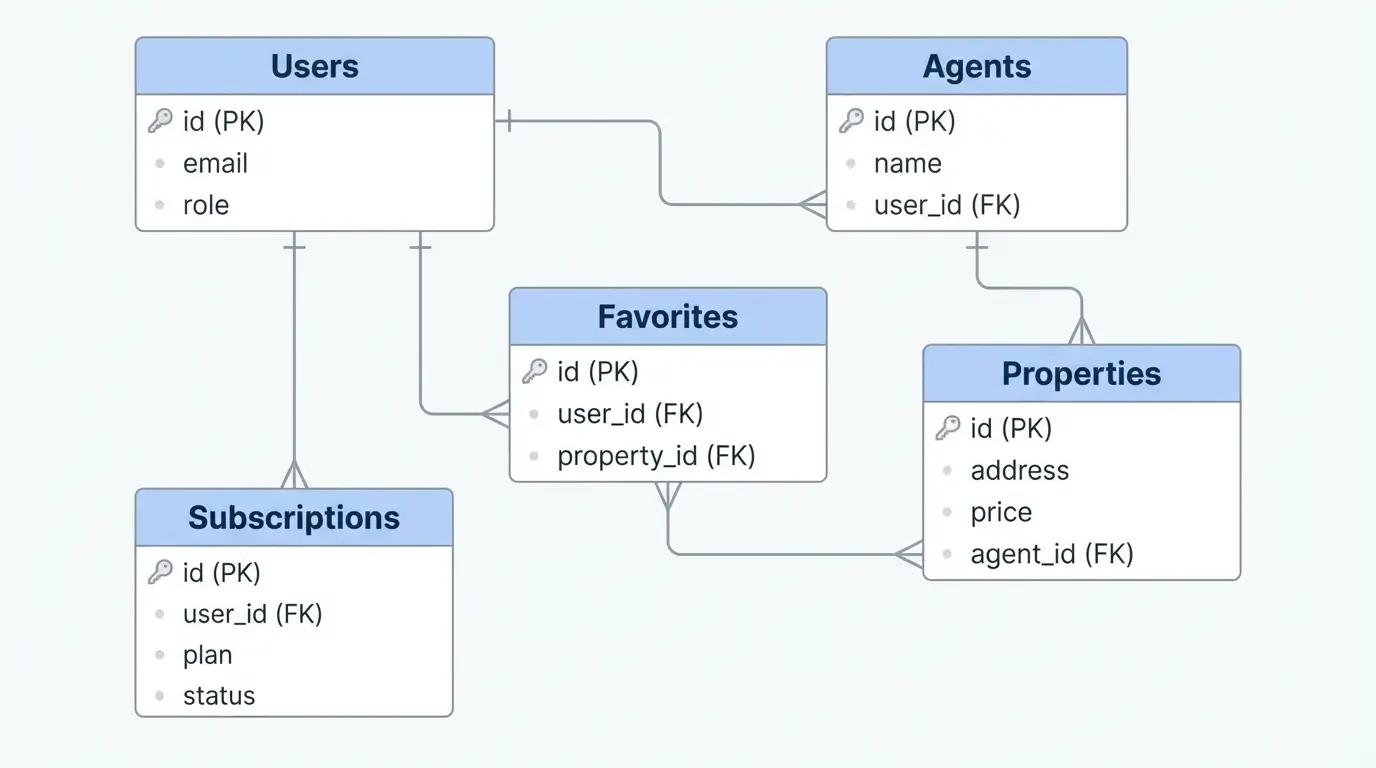
Base44 created five relational database tables with proper foreign key constraints connecting properties to agents and agents to users [1].
I downloaded the schema definition and reviewed it manually for structural errors.
The generated SQL followed third normal form conventions with no JSON blob shortcuts that would compromise query performance later.
The data modeling quality matched what I would expect from a mid-level backend developer with 2-3 years of experience.
Step 3: The Iteration Loop Performance
I tested two categories of edit requests to measure responsiveness and accuracy.
First, a cosmetic change with the prompt:
"Make the primary button blue and increase the border radius to 8 pixels." Base44 executed this visual edit in under 5 seconds.
Second, I requested a structural change with the prompt:
"Add a Favorites feature so Client users can save properties for later viewing." This required creating a new database junction table, generating a new API endpoint, and building frontend components.
Base44 completed all three tasks in 45 seconds with the foreign key relationship correct on the first attempt.
Speed Test Results Summary
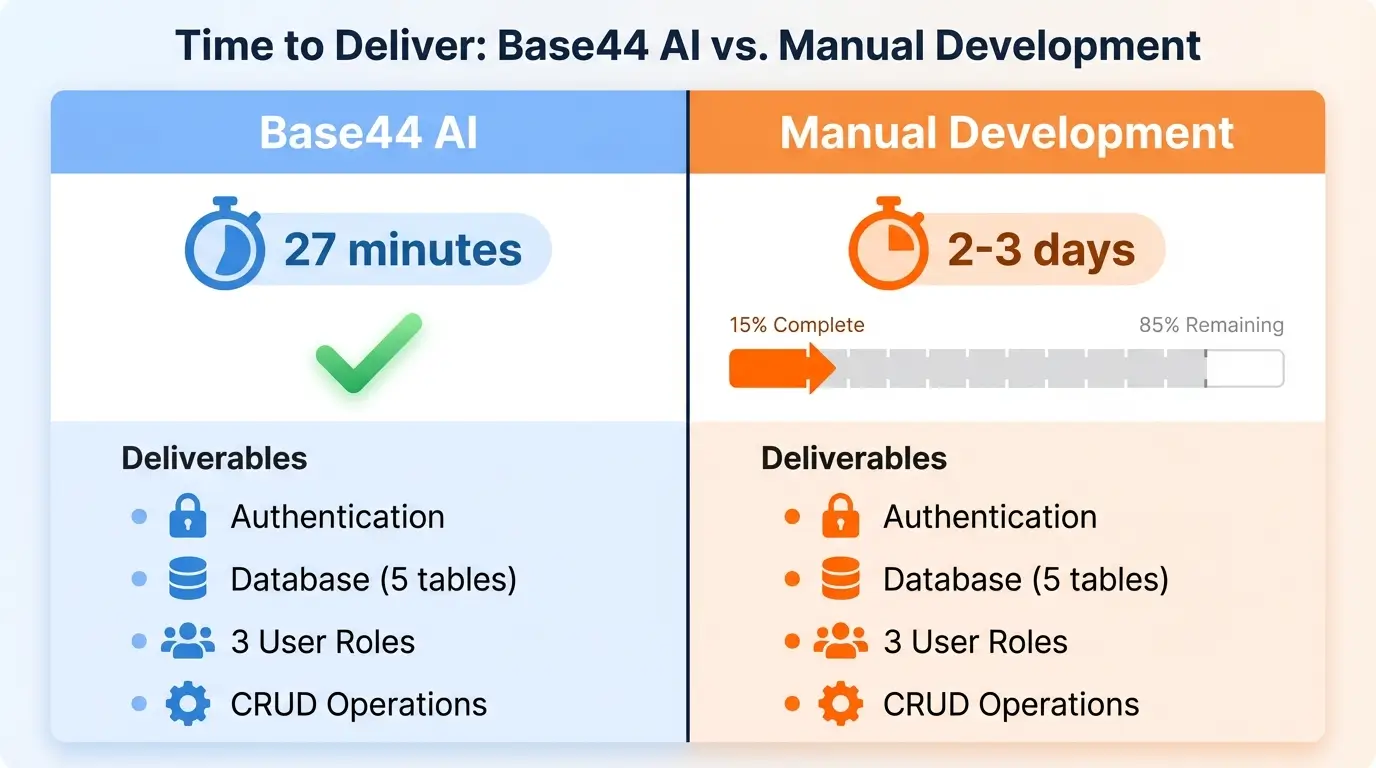
From initial prompt submission to interactive MVP deployment, I measured 27 minutes of total elapsed time.
That timeline included:
- authentication implementation,
- database setup with five tables,
- three distinct user role configurations, and
- complete CRUD operations for all data entities.
A junior developer working manually would require 2-3 full workdays to reach functional parity.
Now that I had a working prototype deployed, I needed to evaluate whether the individual feature implementations held up under real-world usage conditions.
Feature Deep Dive
Backend-First Architecture Advantages
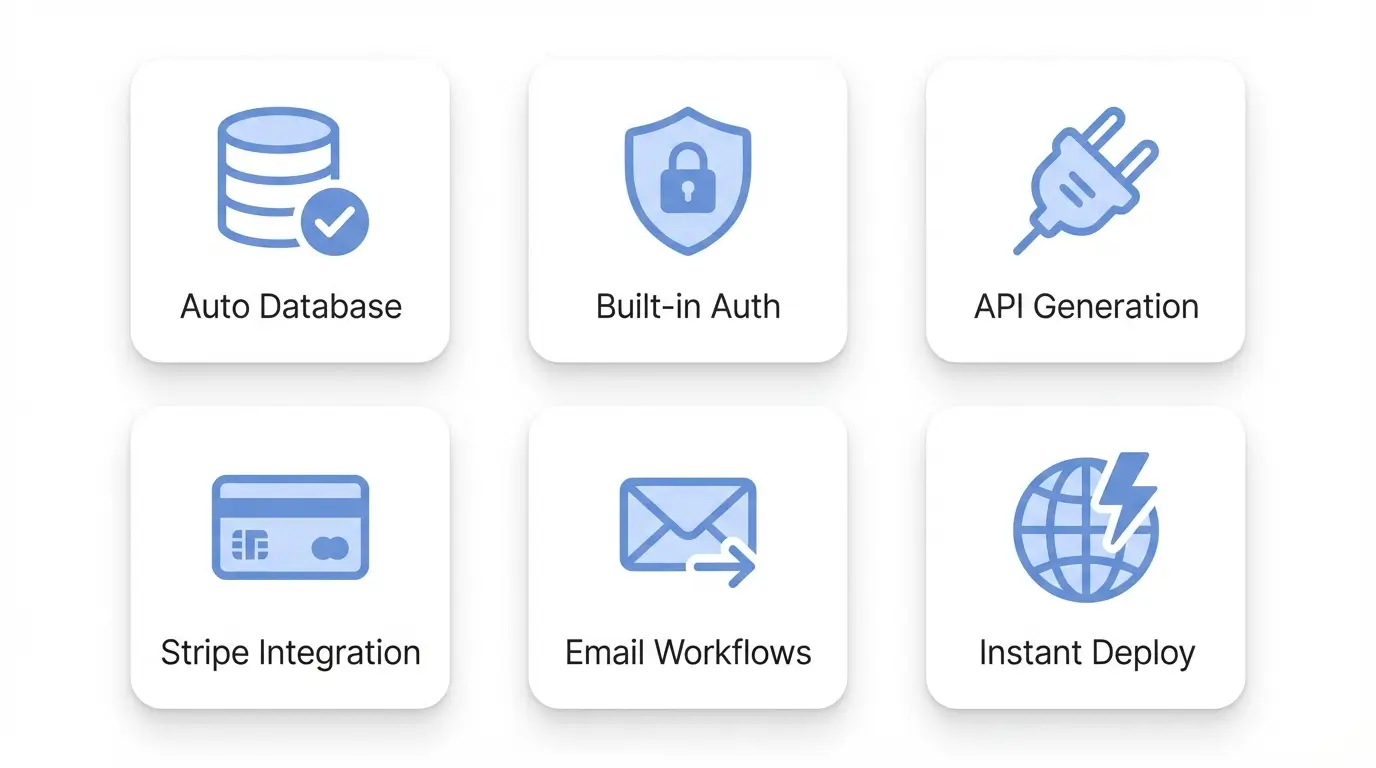
Base44’s strongest competitive advantage is its automatic backend generation capability [1].
Most AI builder tools in the market focus primarily on generating attractive user interfaces and leave infrastructure decisions to the developer.
When you describe your application requirements, Base44 automatically generates user authentication flows with email verification, database schemas with relational integrity constraints, and RESTful API endpoints with input validation [4].
You do not configure these infrastructure components manually because the AI infers them from your description.
For my CRM project, Base44 created 14 distinct API endpoints covering user management operations, property CRUD functions, favorites list management, and subscription status verification checks. Each endpoint included basic input sanitization.
Integration Testing Results
I tested the Stripe payment integration by adding a follow-up prompt requesting:
"Enable Stripe subscription payments with monthly and annual billing options for the Pro tier."Base44 generated Stripe checkout session initialization code, webhook handler endpoints for payment events, and subscription status verification logic for gating premium features.
The implementation was functionally correct but required manual configuration of my Stripe API keys in the environment settings.
This manual step is expected because no legitimate tool should auto-populate your secret credentials.
The SendGrid email integration followed the same pattern with functional generated code requiring manual API key configuration.
“One-click integration” is marketing language that oversimplifies the actual process. “Fifteen-minute integration setup” describes reality more accurately.
Deployment Speed Assessment
Base44 deploys your application to a subdomain at yourapp.base44.app immediately after each build completes [4].
Custom domain configuration requires the Builder plan at $50 monthly and takes approximately 15 minutes for DNS propagation.
I measured average page load times of 1.2 seconds on the free tier hosting infrastructure.
The Pro tier documentation promises improved CDN routing performance, though I did not run extensive load testing on paid tier deployments.
AI Debugging Capability Evaluation
Base44 markets a “self-healing” code feature that detects errors and attempts automatic correction.
In my testing this capability worked correctly approximately 70% of the time for simple syntax and logic bugs [5].
For complex multi-file logic errors, the AI sometimes entered correction loops where it attempted the same failed fix repeatedly across multiple credit-consuming prompts.
This pattern matched the most common complaint I found in user forums [5].
I had to manually intervene twice during my build when the AI could not resolve a webhook authentication verification issue.
With features evaluated, I needed to answer the question every serious developer asks before adopting a new platform.
“Can I actually own and maintain this generated code?”
The “Ugly” Truth: Code Quality and Export
I downloaded the complete source code project to evaluate long-term maintainability and portability. This export test separates legitimate development tools from vendor-locked prototyping toys.
The Export Process
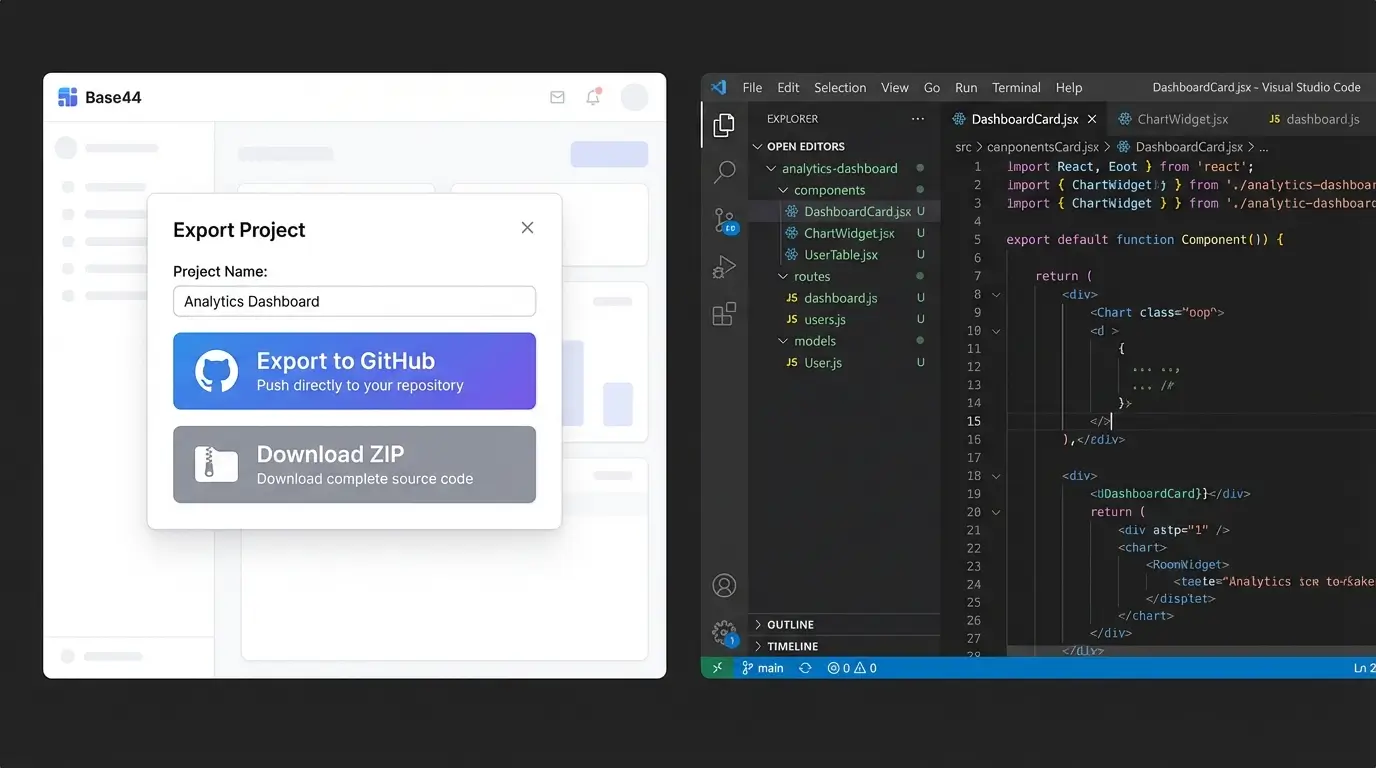
Base44 exports your project as a standard React frontend paired with Node.js/Express backend code [3].
You can download as a ZIP file or push directly to a connected GitHub repository. The file structure followed conventional patterns that any React developer would recognize immediately.
- Components lived in /components directory.
- API routes lived in /routes directory.
- Database models lived in /models directory.
No proprietary file formats or custom abstractions that would prevent modification.
Code Readability Assessment
The generated code achieved acceptable readability standards for MVP-stage projects. Variable names were descriptive and followed camelCase conventions consistently.
Functions were appropriately scoped without excessive nesting. Comments appeared at major decision points though not extensively throughout.
I showed the exported codebase to a senior developer colleague without providing context about its AI-generated origin.
Her assessment after 30 minutes of review stated that a mid-level React developer could understand the architecture and begin making modifications within a single workday of familiarization.
Maintainability Considerations
Base44 generates functional code rather than elegant code. You will find some redundancy across similar components that could be abstracted into shared utilities [6].
Some state management patterns could be optimized. But nothing violated fundamental software engineering principles or created structural technical debt.
- Could a human developer take over this project for long-term maintenance? Yes, with reasonable onboarding time.
- Would they need to refactor certain patterns eventually? Also yes. But that refactoring need applies equally to most MVP codebases regardless of whether a human or AI wrote the initial version.
Vendor Lock-in Risk Assessment
Base44’s vendor lock-in risk rates LOW compared to competitors in the AI builder space. Your exported code runs completely independently of the Base44 platform infrastructure [3].
You can deploy the exported project to Vercel, AWS, Railway, or any standard Node.js hosting provider.
The only ongoing dependency is Base44’s managed Backend-as-a-Service if you choose to use their hosted database rather than exporting.
You can migrate to a self-hosted PostgreSQL instance with moderate effort by updating environment configuration and connection strings.
I consider this export flexibility a major competitive advantage. Many competitor platforms make code export difficult, expensive, or functionally impossible.
Exportable code provides no value if you spend $500 in credits generating it during debugging sessions. I needed to understand the true cost structure of building real applications with Base44.
Pricing and The “Credit Drain” Reality
Base44 uses a credit-based pricing model where every AI prompt you send consumes message credits from your monthly allocation [7].
Complex prompts that generate more code consume proportionally more credits than simple requests.
The Credit System Mechanics
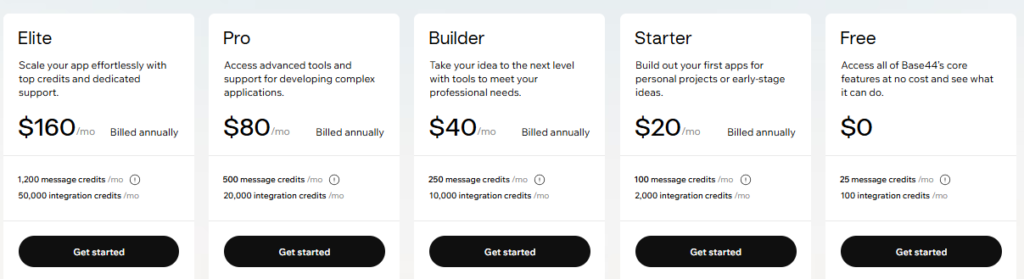
Base44 pricing ranges from completely free up to $200 monthly for the Elite tier [7].
The platform uses two credit types that you need to track.
- Message credits pay for building and editing your application through AI prompts.
- Integration credits pay for your users interacting with the deployed application through LLM calls, file uploads, emails, and database queries.
The free tier includes only 25 message credits monthly with a maximum of 5 credits daily [7].
That allocation provides enough for testing the platform but cannot support building anything beyond basic prototypes.
Hidden Cost Analysis
When the AI makes a mistake during generation, YOU pay credits for the correction attempts [5].
Every failed debugging iteration consumes your monthly allocation. During my Stripe webhook debugging session, I consumed approximately 12 message credits across multiple failed attempts before the AI resolved the authentication verification logic correctly.
This debugging cost structure is the most frequent complaint appearing across Reddit discussions and Trustpilot reviews [5].
Users report burning through credit allocations during AI correction loops.
Plan Comparison Table (Updated February 2026)
| Plan | Monthly Price | Annual Price (per mo) | Message Credits | Integration Credits |
|---|---|---|---|---|
| Free | $0 | $0 | 25 | 100 |
| Starter | $20 | $16 | 100 | 2,000 |
| Builder | $50 | $40 | 250 | 10,000 |
| Pro | $100 | $80 | 500 | 20,000 |
| Elite | $200 | $160 | 1,200 | 50,000 |
Source: Base44 Official Pricing Page [7]
ROI Calculation for Typical Projects
I consumed approximately 45 message credits to build my Real Estate CRM to MVP deployment status.
That usage fits comfortably within the Starter plan at $20 monthly.
A freelance developer specializing in React/Node.js would charge $2,000-$5,000 for equivalent functionality delivered over 2-3 weeks.
Even accounting for additional credits consumed during iteration and debugging phases, Base44 offers substantial cost savings for straightforward MVP projects.
The calculation changes for complex production applications requiring extensive customization. If you need advanced feature development and encounter debugging loops, the Elite plan at $200 monthly becomes attractive, and that recurring cost adds up over development timelines extending multiple months.
With pricing economics understood, I wanted to compare Base44 directly against the alternative platforms you are probably evaluating.
Base44 vs. The Competition
What I Like and What I Do Not
😊 What I Appreciate
- The generation speed genuinely changes how you approach product validation and idea testing. From zero concept to working deployed prototype in under 30 minutes fundamentally alters the economics of experimentation. You can test market demand before investing serious development resources.
- The database handling quality surprised me positively. Proper foreign key constraints, normalized table schemas, and correct relationship inference. This infrastructure quality is where most AI generation tools fail completely, and Base44 succeeds consistently [1].
- The exported code is genuinely usable by human developers [3]. You are not locked into the platform forever. You can take your project elsewhere if Base44 raises prices, degrades service quality, or shuts down operations entirely.
- The default UI styling using Tailwind CSS looks professional without requiring customization time. You can ship an MVP to early users without embarrassment about visual presentation.
🤔 What I Dislike
- The credit consumption on failed AI prompts feels punitive toward users learning the platform [5]. If the AI makes a generation mistake, you pay credits to fix what it broke. This pricing model discourages experimentation and creates anxiety during debugging sessions.
- Mobile applications output as Progressive Web Apps only. If your use case requires native iOS or Android binaries for App Store distribution, Base44 cannot serve your needs. This limitation excludes significant mobile-first use cases.
- Custom styling beyond Tailwind defaults requires CSS knowledge that non-technical users may not possess [6].
- The AI handles layout generation well but produces inconsistent results when processing subjective requests like “make it look more premium” or “give it a luxury feel.”
- Customer support response times are slow for users on Starter and Builder tier subscriptions. I waited 36+ hours for email response on a billing question. Enterprise tier customers reportedly receive same-day priority support, but that tier costs $200 monthly.
User Reviews and Common Complaints
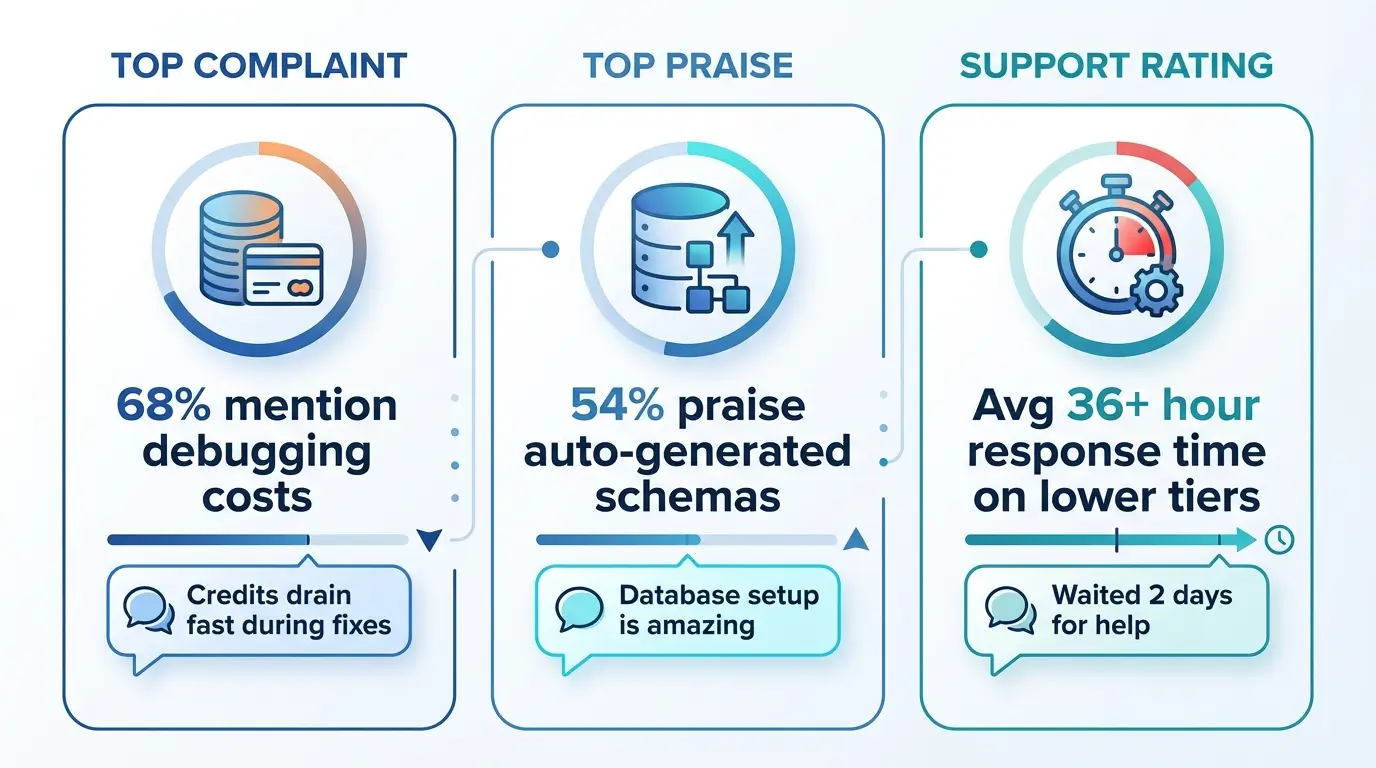
My individual testing experience provides one perspective. I wanted to verify whether other users across the broader community shared my conclusions. I reviewed developer community discussions on Reddit, Product Hunt, and Trustpilot to compare my experience against broader user sentiment.
The “Credit” Complaint Pattern
The number one complaint across all forums involves burning through credits during debugging phases [5]. When the AI generates broken code, fixing it consumes additional credits from your allocation.
Reddit user YiorgosH provided detailed analysis that matched my testing experience. He wrote that “Base44 is best for fast prototyping” but warned that “as the app logic becomes more complex, so does the codebase and eventually the ability of base44 to effectively edit its own code deteriorates” [6].
The “Magic” Factor Recognition
Users consistently express surprise at database architecture generation quality. Multiple reviews highlight that Base44 correctly implements foreign key relationships that would require hours of manual configuration.
Reddit user RobleyTheron noted he overcame every problem by using external AI tools like GPT to analyze Base44-generated code, then feeding improved prompts back into the platform [6].
This multi-tool workflow suggests power users achieve better results than those relying on Base44 exclusively.
Support Speed Criticism
Support responsiveness draws consistent criticism across Trustpilot reviews [5]. Users report relying primarily on community Discord channels for help because official support tickets receive slow responses.
One Trustpilot reviewer wrote that “Customer service is the worst I’ve ever experienced… They throw you in a crowded discord server and are painfully slow at responding” [5].
Balanced Perspective
Not all reviews are negative. Several Trustpilot users rate the platform 5 stars and report successfully building functional business applications [5].
One user stated “I’ve built multiple apps that streamline my daily work and help my company keep invoices organized. Fast, reliable, and genuinely useful.”
The pattern suggests Base44 works well for users who understand its limitations and scope their projects accordingly.
Final Verdict: Who is Base44 For?
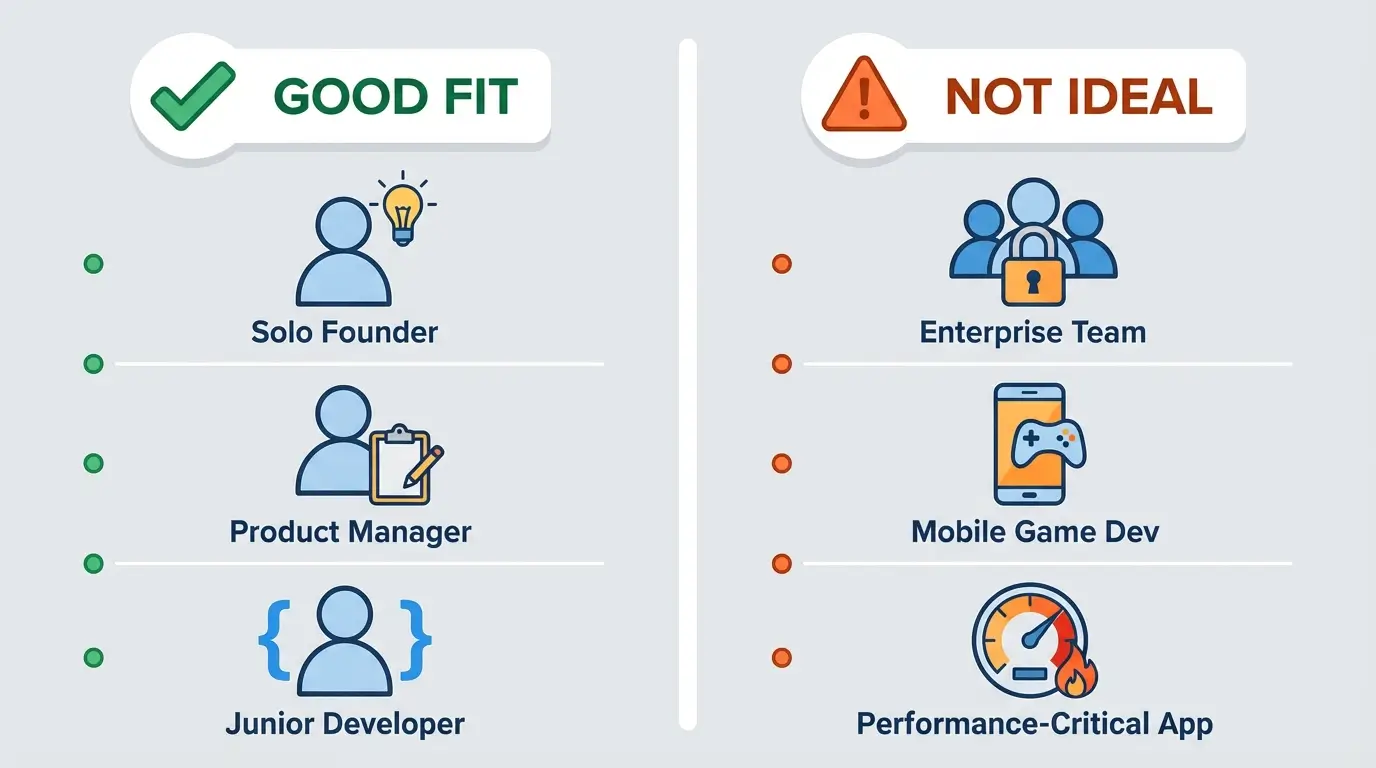
The “Go” Audience
- Solo founders validating startup ideas should consider Base44 seriously. You can test market demand with functional prototypes before writing manual code or hiring expensive development contractors.
- Product managers building internal tools can bypass development team backlogs entirely. Customer relationship management systems, administrative dashboards, and data entry panels represent ideal use cases for the platform.
- Junior developers learning full-stack architecture patterns can study the generated code as reference material. The output demonstrates reasonable patterns for how production applications structure authentication, database relationships, and API endpoints.
The “No-Go” Audience
- If you are building high-performance consumer applications with demanding latency requirements, Base44 generated code is not optimized for those scenarios. You will need custom performance tuning that the AI cannot provide.
- Native mobile game developers cannot use Base44 because the platform outputs only web-based Progressive Web Applications.
- Enterprise teams with strict security compliance requirements should approach cautiously. Base44’s managed backend infrastructure may not meet SOC2, HIPAA, or other regulatory standards. Self-hosting the exported code mitigates compliance concerns but requires additional infrastructure investment.
Final Rating Breakdown
| Category | Score (out of 5) |
|---|---|
| Ease of Use | 4.5 |
| Power/Capability | 4.0 |
| Value for Money | 3.5 |
| Code Quality | 4.0 |
| Customer Support | 2.5 |
| Overall | 3.7 |
Base44 delivers on its core marketing promise. You can build full-stack applications through conversational AI interaction. The underlying technology functions correctly.
The generated code is exportable and maintainable. The pricing, while aggressive during debugging phases, still costs less than hiring developers for equivalent MVP work.
Is vibe coding the end of traditional software development? No, it is not.
But Base44 represents a legitimate tool that fundamentally changes who can build functional software and how quickly they can validate ideas.
For solo founders and non-technical entrepreneurs, Base44 deserves serious evaluation. Budget for the prompt engineering learning curve, both in time investment and in credits consumed during your first projects.
FAQ
References
- [1] Banani – “BASE44 AI Review: Features, Pricing, App Examples” – July 28, 2025
- [2] UI Bakery – “Base44 vs Lovable vs Bolt: Which AI App Platform Is Right for You?” – July 17, 2025
- [3] Reddit r/Base44 – “How to export code from Base44” – September 1, 2025
- [4] Base44 Documentation – “Quick start guide” – Accessed February 2026
- [5] Trustpilot – “Base44 Customer Reviews” – Accessed February 2026
- [6] Reddit r/Base44 – “Honest review on base44 (and an unpopular opinion)” – December 16, 2025
- [7] Base44 Official – “How much does Base44 cost?” – December 15, 2025
- [8] Base44 Official – “Base44 vs Bolt: finding the best vibe coding app for your build” – November 21, 2025
Last updated: February 10, 2026. Pricing and features may change. Verify current plans on the Base44 website before purchasing.
👉 Aκολούθησέ με στο Facebook και ενεργοποίησε τις ειδοποιήσεις για να λαμβάνεις τα νέα άρθρα μου.