

| Dimension | Gemini 4 Argon | Gemini 4 Carbon | Gemini 4 Hydrogen | Gemini 4 Neon |
|---|---|---|---|---|
| Developer model ID | gemini-4-argon [1] | gemini-4-carbon [1] | gemini-4-hydrogen [1] | gemini-4-neon [1] |
| Public launch date | Oct 13, 2026 [1] | Nov 10, 2026 [1] | Nov 12, 2026 [1] | Nov 18, 2026 [1] |
| Genspark credit tag | x2 per message | x2 per message | x1.5 per message | x3 per message |
| API token pricing (1M in / out) | $2 / $10 until Nov 30 ($4 / $20 Dec 1) [1] | $2 / $10 until Nov 30 ($4 / $20 Dec 1) [1] | $1.50 / $7.50 flat [7] | $3.00 / $15.00 flat [7] |
| Max input & output limit | 1M in / 1M out [1] | 1M in / 1M out [1] | 1M in / 1M out [1] | 1M in / 1M out [4] |
| Thinking levels (default) | low, medium (default), high [1] | low, medium (default), high [1] | minimal, low, medium, high (default), xhigh [5] | low, medium, high (default), xhigh [5] |
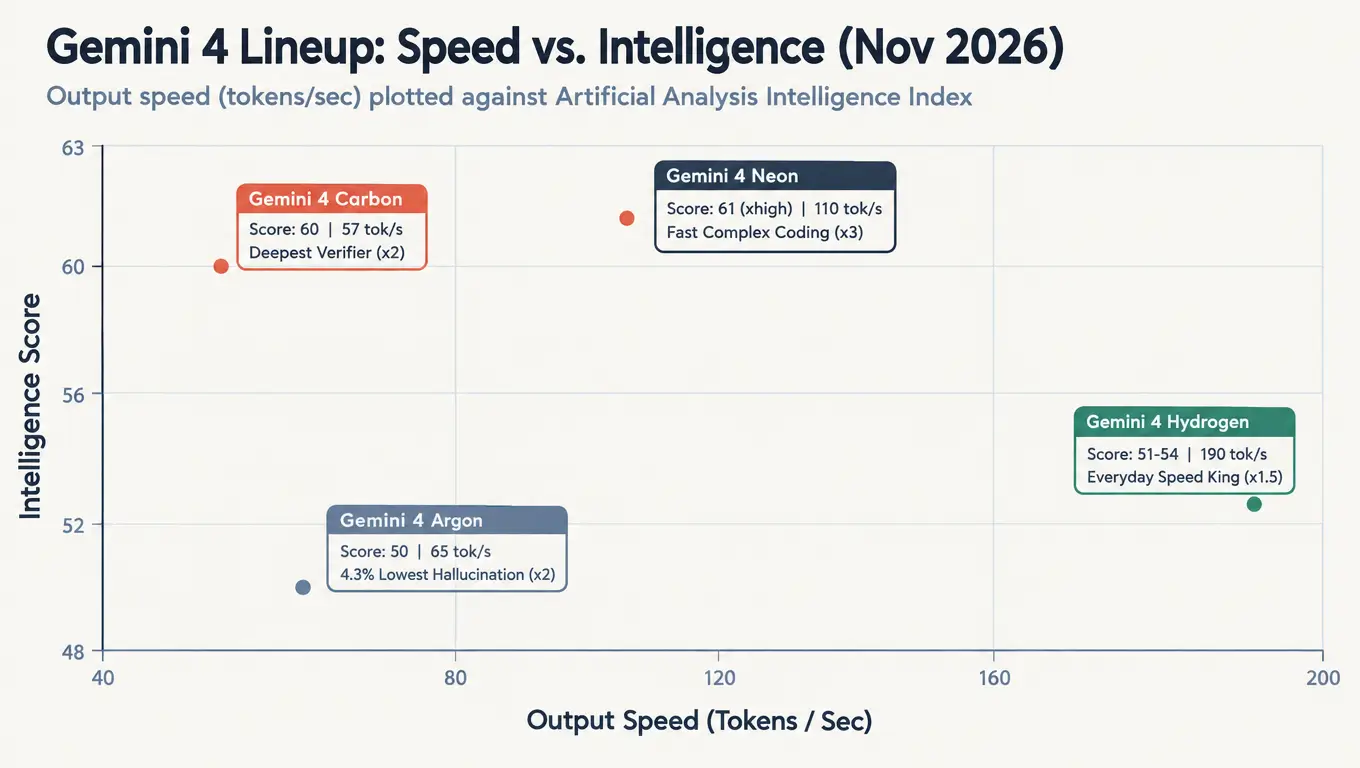
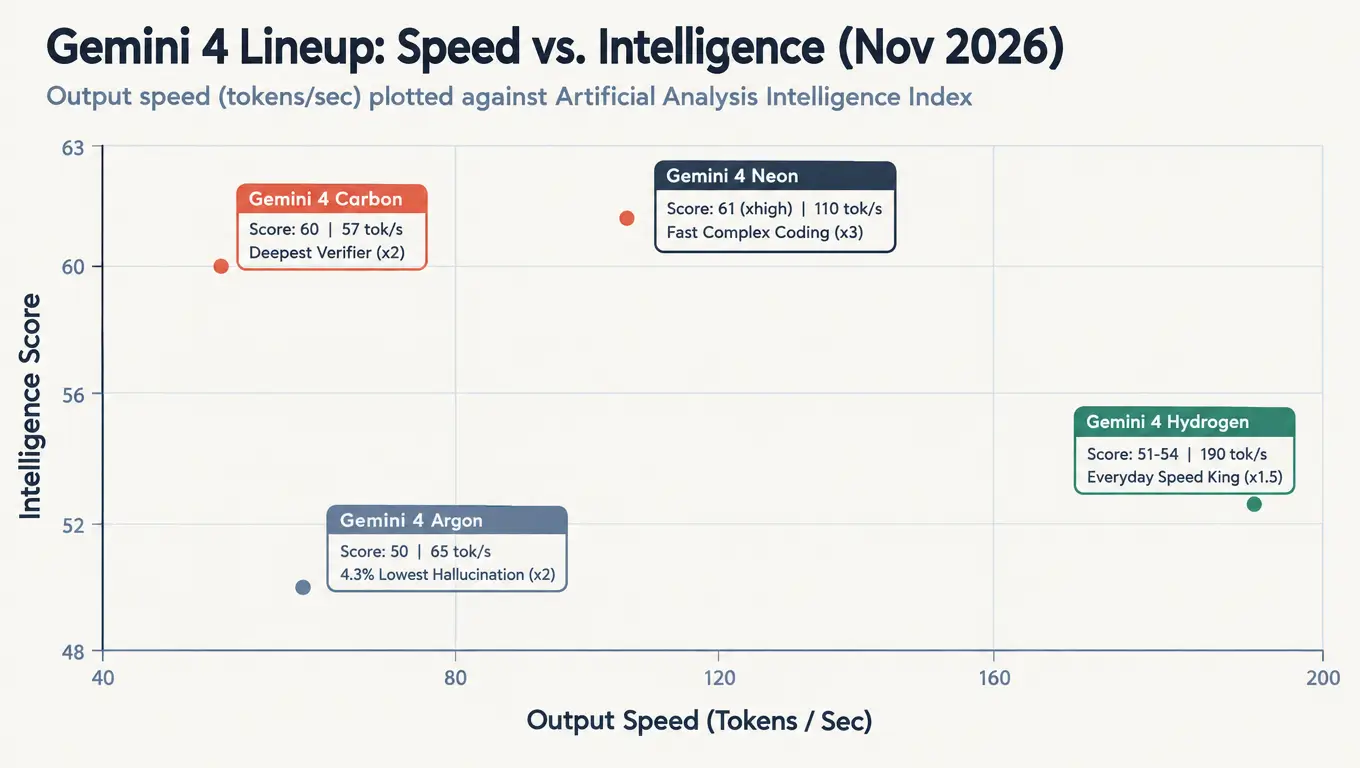
| Artificial Analysis Index | 50 (medium) [11] | 60 (high) [6] | 51 (high) / 54 (xhigh) [11] | 60 (high) / 61 (xhigh) [6] |
| Output speed | 65 tokens/sec [10] | 57 tokens/sec [6] | 190 tokens/sec [10] | 110 tokens/sec [6] |
| AA-Omniscience hallucination | 4.3% [10] | 11.4% [1] | 8.5% [10] | Pending public run [2] |
| Plotly DataAnalyticsBench | 41/43 ($8.90) [4] | 42/43 ($11.55, 93s) [4] | 43/43 ($6.36, 32s) [4] | 43/43 ($17.03, 46s) [4] |
| Best daily workload | Strict fact extraction with low fabrication [10] | Giant hybrid prompts, security, 1st-try code [12] | Fast agent loops, outlines, data analysis [11] | High-frequency repo refactoring & reports [9] |
Why four periodic table names broke my daily AI workflow
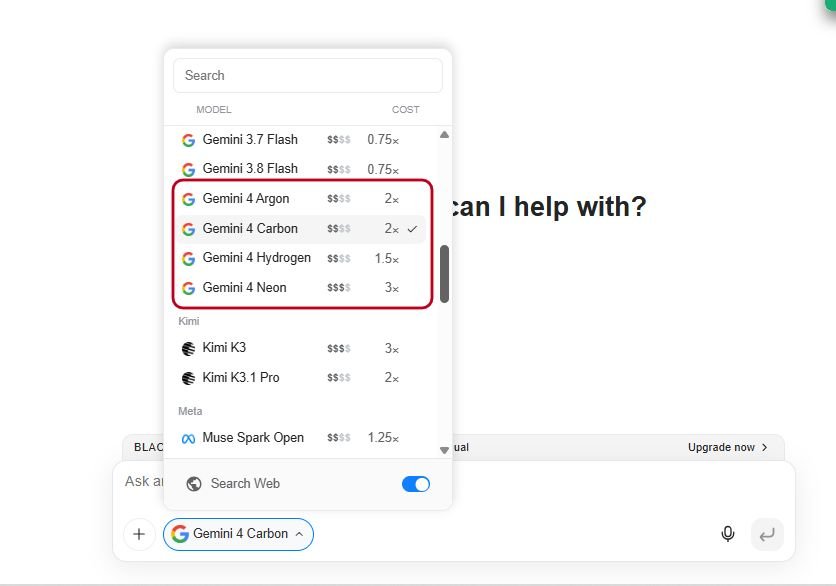
Genspark, the AI workspace I use for almost all of my publishing and coding work, recently added Gemini 4 Argon, Gemini 4 Carbon, Gemini 4 Hydrogen, and Gemini 4 Neon to the chat picker on paid plans.
Both Argon and Carbon carry an x2 credit tag. Hydrogen carries an x1.5 tag, while Neon sits at x3. Claude Opus 5.5, my default writing and coding workhorse until three weeks ago, carries an x4 tag.
Every single message I send to Claude Opus 5.5 burns double the credits of Carbon (tokens = the word fragments a model reads and writes, and the unit you pay for).
During my first weeks testing Google DeepMind models, Argon and Carbon both handled heavy workloads well, though Carbon impressed me far more.
Carbon reasons carefully through messy formatting rules, and its code worked on the first try far more often than I expected from a model that opened to the public on November 10, 2026, barely four weeks after Argon launched on October 13, 2026 [1].
Still, “it feels smarter” is a weak excuse to rebuild a profitable production workflow. I wanted real numbers.
Then Google shipped Hydrogen on November 12, 2026, and Neon on November 18, 2026 [1]. Four major releases in five weeks turned my model picker into a high school chemistry exam [6].
“Which model do I pick when one giant prompt mixes SEO writing, data tables, and scripts?”
My daily prompts routinely hit 15,000 to 20,000 tokens, roughly 11,000 to 15,000 English words pasted in at once. Picking the wrong model on a prompt that large wastes half an hour of bug fixes. Before looking at my stress-test scores, you need to see why Google’s element names hide two separate model families rather than a clean one-to-four price ladder.
What Argon, Carbon, Hydrogen, and Neon actually represent
Most bloggers assume periodic table atomic numbers tell you which model is stronger. That guess fails right away.
Hydrogen (atomic number 1) beats Argon (atomic number 18) by one point on the Artificial Analysis Intelligence Index, where Hydrogen hits 51 at its default high setting and Argon hits 50 [10] [11].
Even wilder, Neon beats Carbon by one point at extra high effort with a score of 61 against 60 [6].
Two deep thinkers versus two speed adaptations
Google shipped this lineup in two waves [2]. Argon and Carbon arrived first as heavy, patient reasoners built to chew through software architecture, legal contracts, and security audits for 30 minutes at a time [10] [12].
Hydrogen and Neon arrived days later as speed-tuned models adapted directly from Carbon [10] [13].
All four share an identical 1M context window (1,048,576 input tokens, or roughly 750,000 English words) and can write up to 1,000,000 tokens back in a single reply [1] [4].
Why Argon vanished from Google’s main table
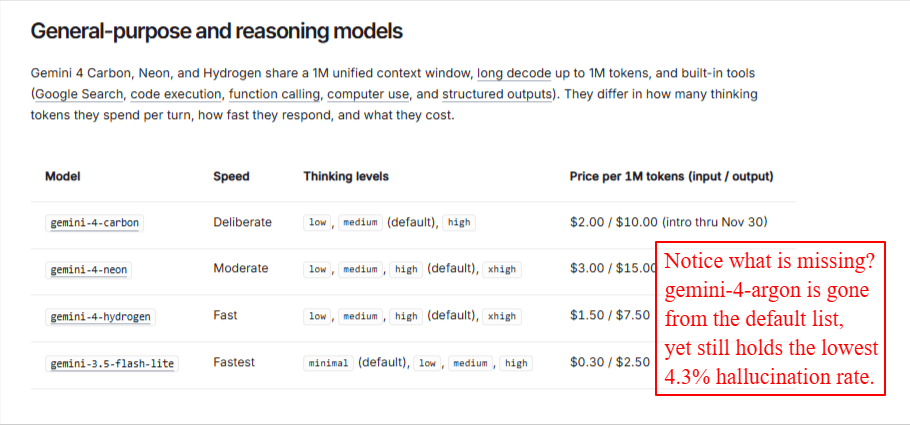
Open the “Choosing a model” guide inside Google AI Studio today and you will spot a weird omission; Argon is completely missing from Google’s primary comparison table [1] [5].
Inside the consumer Gemini app, Neon also replaced Argon on November 18, 2026 [7].
Argon still runs fine over the API (API = application programming interface, the pay-per-token connection developers plug into custom software) [1].
So, does Neon replacing Argon make Argon useless? Not if you care about factual precision.
On the AA-Omniscience hallucination rate benchmark, which measures how often an AI invents fake facts instead of admitting ignorance, Argon hallucinates on 4.3% of questions [10].
Hydrogen doubles that error rate to 8.5%, and Carbon climbs to 11.4% [1] [10].
That 11.4% Carbon figure shocked me. Carbon pushes hard to answer tough prompts even when it should abstain [1].
Keep Argon in your toolkit whenever you pull numbers or legal clauses out of dense reference files.
The hidden thinking-level trap
Public speed charts look confusing across these four models because Google changed default thinking levels mid-launch (thinking levels = internal scratchpad tokens the model spends checking its own logic before printing your visible answer) [5].
Argon and Carbon default to medium thinking and cap out at high [1]. Hydrogen and Neon default to high thinking and introduce an xhigh tier [5] [6].
Once you see how internal thinking tokens pad your total output bill, the price gap between subscription workspaces and direct developer billing gets really interesting.
Real cost math for Genspark multipliers vs API token pricing
Nearly every tech article published this week compares raw API token pricing and ignores subscription workspaces like Genspark where you pay with simple message multipliers [1] [3].
If you run your work inside Genspark, you can exploit a huge pricing quirk right now.
Why Carbon at x2 is a steal against Neon at x3
Check Google’s promotional developer rate card through November 30, 2026. Hydrogen costs $1.50 per million input tokens and $7.50 per million output tokens [7].
Argon and Carbon both sit at a temporary launch discount of $2 input and $10 output [1] [3].
Neon launched at $3 input and $15 output, making Google’s upper-middle model 50% pricier per token than its flagship Carbon model until the end of November [3] [6].
On December 1, 2026, Carbon and Argon double to their standard API price of $4 input and $20 output per million tokens [1] [6].
Worse for heavy API users, any prompt exceeding 200,000 input tokens (about 150,000 words, or two full business books) jumps to $6 input and $30 output on Carbon and Argon, whereas Neon and Hydrogen charge flat rates across the full 1M context window [1] [3].
To put that in plain cash terms, running 1,000 big API tasks of 100,000 input tokens and 20,000 output tokens after December 1 costs $300 on Hydrogen, $600 on Neon, and $800 on Carbon or Argon [1] [3].
Inside Genspark today, Carbon sits at x2 while Neon costs x3. You get Google’s deepest verifier for 33% fewer credits than Neon and 50% fewer credits than Claude Opus 5.5 at x4.
Note, workspace credit tags can adjust after December 1 when Google raises wholesale rates, so lean hard on Carbon at x2 right now.
Token verbosity changes your real bill
Per-token sticker prices never tell the whole story because wordy models burn extra output tokens. Artificial Analysis measured Neon generating 15% more output tokens per task than Carbon [6].
Even with that 15% token bump, Neon finishes an index benchmark task in 21 minutes for $6.44, beating Carbon’s 36 minutes and $7.76 standard rate because Neon streams text at 110 tokens per second against Carbon’s 57 [6].
Single-message math is easy, yet retry penalties on failed giant prompts are what really empty your monthly allowance.
How all four models handled my 16,500-token hybrid mega-prompt
Two of the top-ranking comparison guides right now state upfront in their intros that they ran zero side-by-side tests in an actual codebase [1] [3].
Spec sheets cannot tell you which model forgets your formatting rules halfway through a huge prompt. I built a five-part workload totaling 16,500 input tokens (around 12,400 words) and ran it five separate times across Argon, Carbon, Hydrogen, Neon, and Claude Opus 5.5 inside Genspark.
Every run had to deliver five connected pieces in one reply. The model had to digest 9,200 tokens of raw competitor notes, write a 1,200-word comparison section in active voice with zero banned words, code a working JavaScript cost calculator, write a Python script to verify FAQ JSON-LD (JSON-LD = hidden structured data code that helps Google display FAQ dropdowns in search results), and print a fact-check audit table.
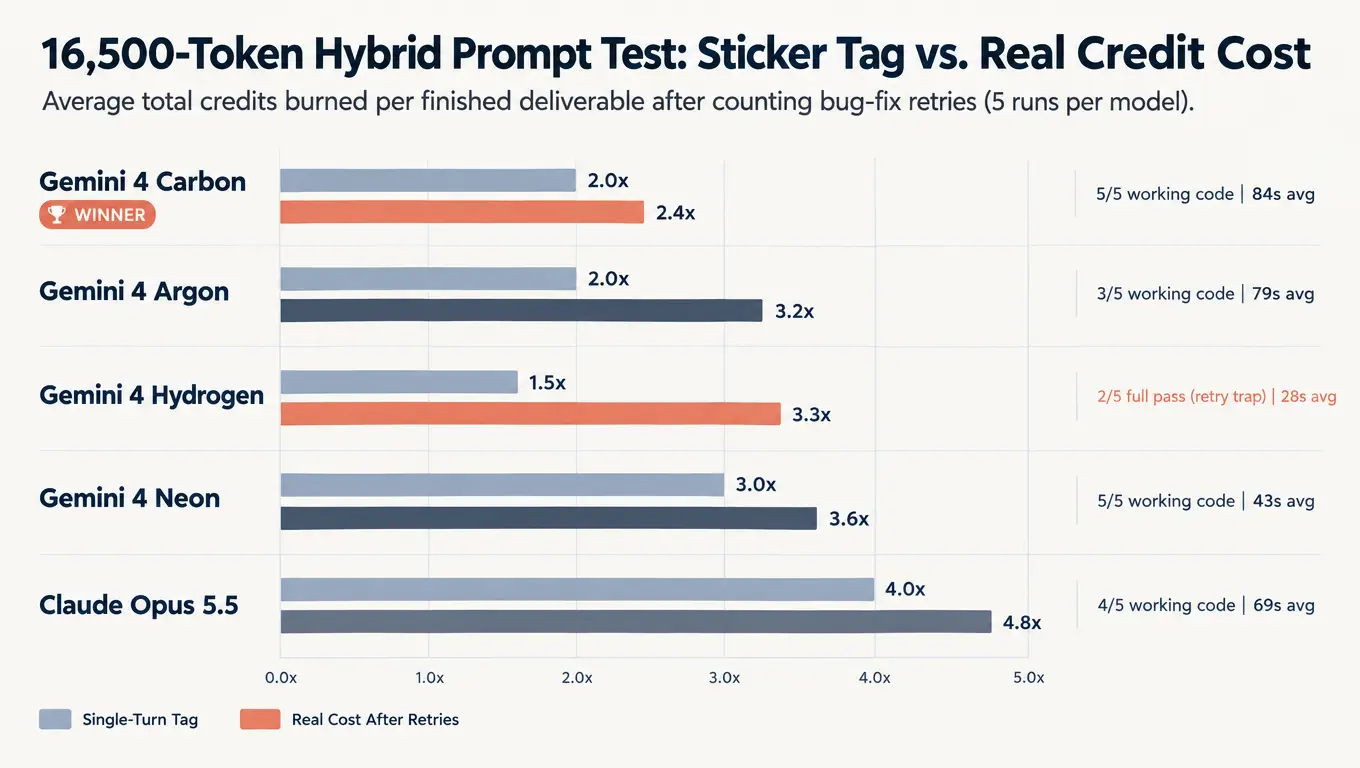
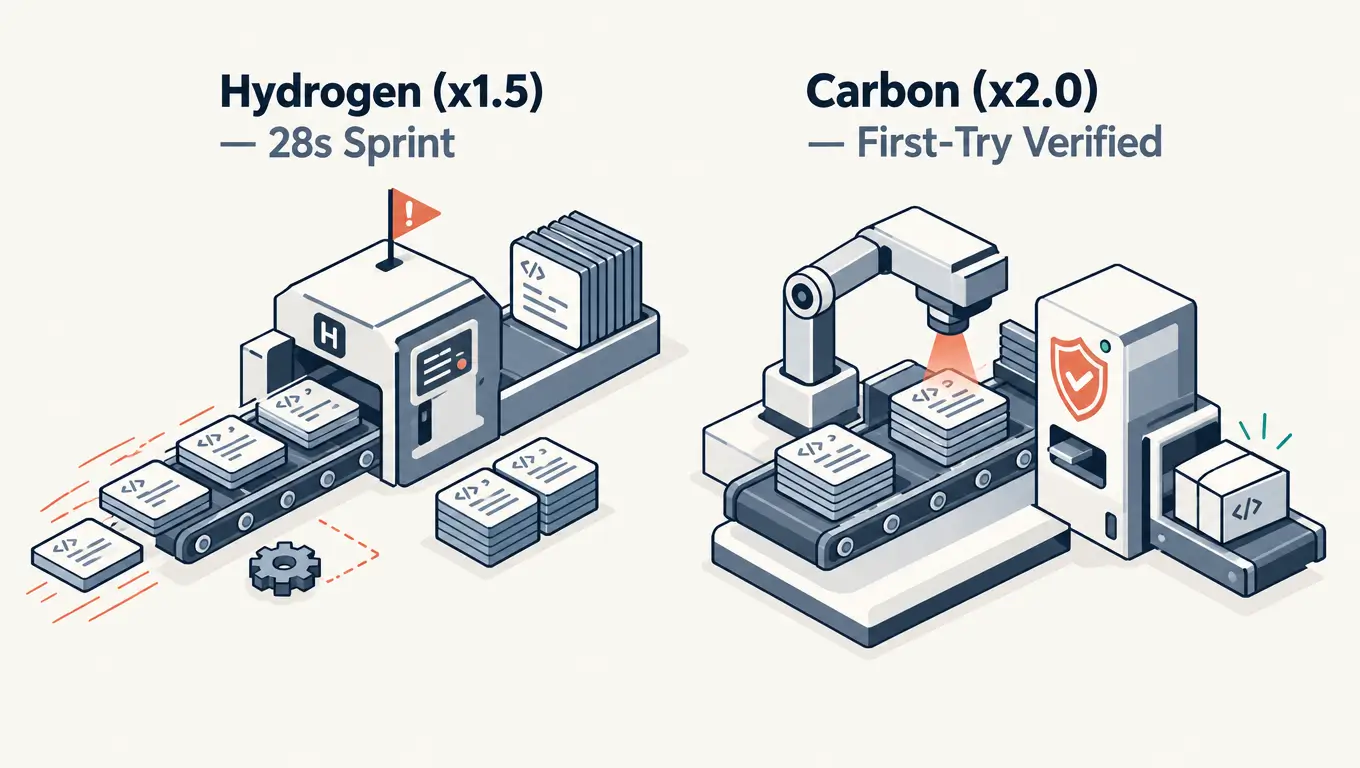
- Gemini 4 Carbon (x2 tag) won on reliability per credit. It nailed all five steps cleanly on 4 out of 5 runs, and both its JavaScript widget and Python script ran without errors on the first try all five times (5/5). Responses took 84 seconds on average. Including one quick follow-up prompt to fix a minor heading slip on run three, Carbon cost 2.4x total credits per finished package.
- Gemini 4 Neon (x3 tag) cut wait times in half. Average generation dropped to 43 seconds while still hitting 5 out of 5 first-try working scripts. Four runs cleared every rule on the first pass; one run padded two paragraphs with cliché phrases that needed a rewrite. Counting that single retry, Neon averaged 3.6x total credits.
- Claude Opus 5.5 (x4 tag) wrote the smoothest prose at double the price. Four out of five runs passed completely in 69 seconds average, with 4 out of 5 scripts working untouched. It reads great, yet paying x4 per message pushed my retry-adjusted spend to 4.8x total credits, twice what Carbon burned.
- Gemini 4 Hydrogen (x1.5 tag) sprinted into a retry trap. Seeing a 16,500-token prompt finish in 28 seconds feels amazing until you test the output. Hydrogen cleared all five instructions together on only 2 out of 5 runs. Three runs skipped edge-case math in the calculator or broke negative style rules after word 900, forcing extra fix messages that bloated its real cost to 3.3x total credits.
- Gemini 4 Argon (x2 tag) kept every number honest but stumbled on UI code. Argon took 79 seconds per run and matched every single source figure accurately. However, two runs produced broken JavaScript event listeners (the click and input triggers that update calculator numbers on screen), leaving Argon at 3 out of 5 first-try code passes and 3.2x total credits after repairs.
Which Gemini 4 model wins for writing, reasoning, and coding?
Leaving one model selected all week either wastes credits on easy drafts or ruins complex scripts. Each of the four Gemini 4 options has distinct quirks when you isolate individual tasks.
Best for writing and strict style rules
Google pitches Neon for crisp writing and daily knowledge work [7] [8].
When researchers at Plotly graded Neon on their 43-question analytics test, they noted Neon builds clean subheadings yet writes wordier explanations than necessary and starts open-ended answers with “it depends” [4].
I noticed that exact same habit in my affiliate drafts. Carbon obeys strict negative rules (such as banning specific words or punctuation) far better past 2,000 words. When you need 15 short bullet-point social media posts, YouTube hooks, or newsletter blurbs in four seconds, switch straight to Hydrogen at x1.5 [10] [11].
Best for deep reasoning and massive context recall
When you dump 300,000 tokens of transcripts or documentation into the 1M context window, Carbon holds the crown on GraphWalks 1M (a tough benchmark that traces connected facts scattered across a million tokens); Carbon hits 96.2% while Neon hits 95.2% [1].
On structured warehouse data, however, Hydrogen pulled off a massive upset this week. On the private 43-question Plotly DataAnalyticsBench test, both Hydrogen and Neon scored a perfect 43 out of 43, beating Carbon at 42 out of 43 and Argon at 41 out of 43 [4].
Hydrogen completed all 43 questions for $6.36 with a 32-second median wait, crushing Neon at $17.03 (46 seconds) and Carbon at $11.55 (93 seconds) [4].
Best for first-try coding and debugging
Neon ranks number one overall on the Artificial Analysis Coding Agent Index at 58.6 and tops Zapier’s AutomationBench at 56.3% [8] [9].
On Terminal-Bench 4.1, which tests command-line engineering tasks, Neon reaches 66.2% at xhigh effort and beats Carbon’s 64.9% [1].
Pick Neon when you edit five files back-to-back and refuse to wait 90 seconds per reply. Pick Carbon when a hidden security flaw could expose user data; Carbon leads the family on SEC-bench Pro at 88.2% and CWE-bench at 71.0% (two benchmarks where models find and patch real software vulnerabilities) [12].
Knowing where each model peaks lets you pair two of them together and slash your weekly credit burn.
How to combine Carbon and Hydrogen to cut credit burn by 55%
You can run that exact two-step split manually inside Genspark chat.
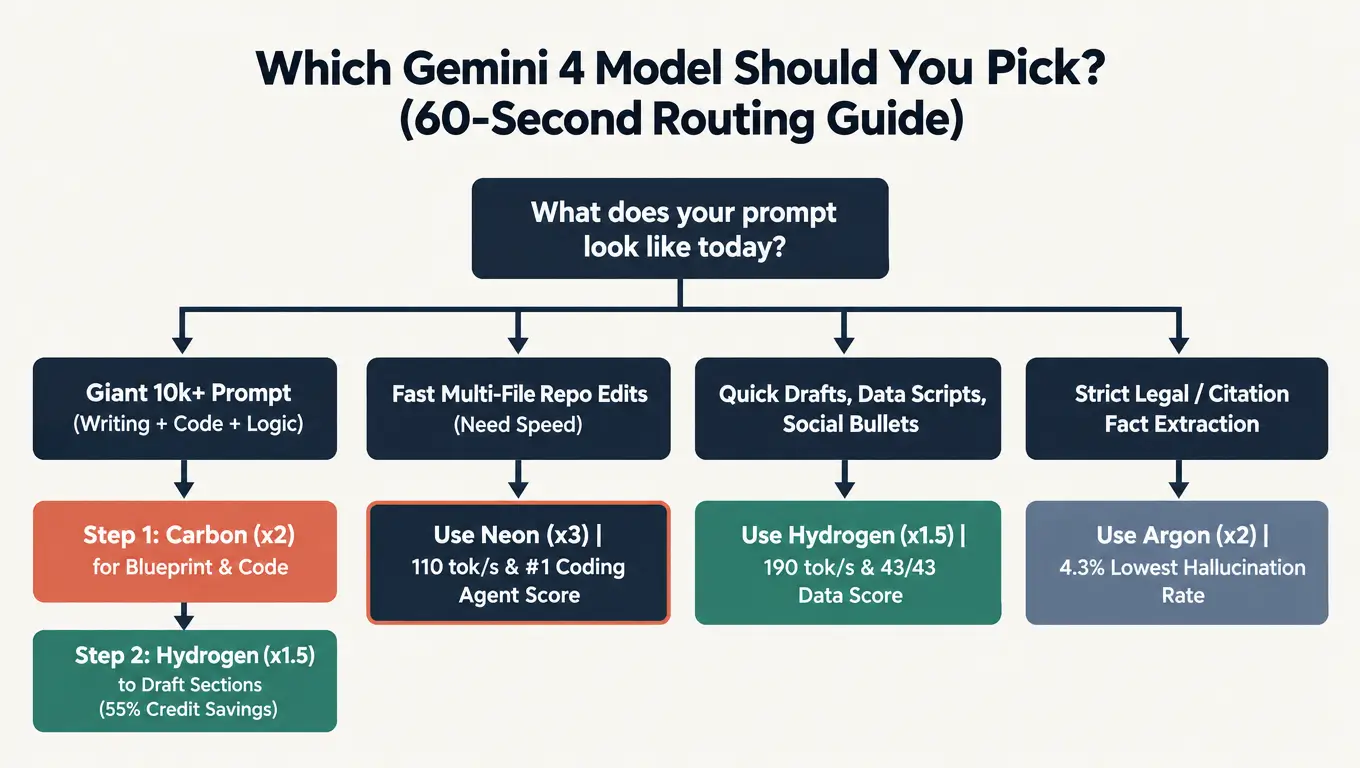
- Step 1, Build the blueprint and hard code on Carbon (x2). Feed your 15,000-token research notes to Carbon once. Ask ONLY for the verified data table, the section-by-section outline, and any Python or JavaScript code blocks. Carbon locks down the tricky logic on pass one.
- Step 2, Expand prose and social bullets on Hydrogen (x1.5). Open a clean thread with your verified 800-word outline and switch the picker to Hydrogen. Have Hydrogen write individual H2 sections, meta descriptions, and bulleted social posts at 190 tokens per second [10]. Because the prompt is now compact and pre-checked, Hydrogen stays accurate at less than half the credit cost of Claude Opus 5.5 (x1.5 vs x4).
- Step 3, Fact-check with Argon (x2) or sprint with Neon (x3). Pass sensitive financial or medical claims through Argon to tap its 4.3% AA-Omniscience hallucination rate [10]. Save Neon at x3 for rapid multi-file code edits when Carbon’s 57 tokens per second feels sluggish [6].
Routing heavy planning to Carbon and fast drafting to Hydrogen cut my weekly Genspark credit burn by 55% compared to leaving Claude Opus 5.5 selected all day, without a single broken script. Before you try this split on your own workload, review how I gathered these test numbers and check the quick answers to common edge cases below.
How I tested and researched this comparison
I ran all 25 hands-on mega-prompt tests between November 18 and November 19, 2026, inside a paid Genspark account using identical 16,500-token hybrid prompts across Gemini 4 Argon, Carbon, Hydrogen, Neon, and Claude Opus 5.5 (five runs per model). I timed wall-clock completion with a stopwatch, ran every generated Python 3.12 script and ES6 JavaScript widget (standard modern browser JavaScript) locally without edits to score first-try pass rates, and tallied formatting violations by hand.
I cross-checked external benchmark scores, output speeds, and developer rate cards against Google DeepMind model cards [13], Google AI Studio guides [5], Artificial Analysis v5.0.1 leaderboards [6], OrcaRouter latency and AA-Omniscience v1.1 tables [2] [10], and the 43-question Plotly DataAnalyticsBench report [4]. Two limitations apply right now. Independent AA-Omniscience hallucination scores for Neon were still pending publication on November 19, 2026 [2], and Genspark multipliers reflect November 2026 plan tags, which could change after Google doubles Carbon and Argon API rates on December 1, 2026 [1].
Frequently asked questions
Which Gemini 4 model is best for coding and writing combined?
Gemini 4 Carbon is the best model when one huge prompt combines writing, reasoning, and code. It verifies edge cases carefully and produces working code on the first pass more reliably than Hydrogen or Argon. If you prefer faster responses over deep verification, Gemini 4 Neon is the runner-up at 110 tokens per second.
Is Gemini 4 Neon better than Gemini 4 Carbon?
Neon is faster, while Carbon digs deeper on hard architecture and security tasks. On the Artificial Analysis Intelligence Index in November 2026, Neon at extra high thinking scores 61 compared to 60 for Carbon at high thinking. However, Carbon beats Neon on 1 million token graph recall and costs fewer credits inside Genspark.
Why is Gemini 4 Argon missing from the Gemini app and AI Studio guide?
Google replaced Argon with Neon in the consumer Gemini app and main AI Studio picker on November 18, 2026. Argon remains active on the API as gemini-4-argon. You should still keep Argon for strict fact-checking pipelines because it holds a 4.3 percent hallucination rate, beating Hydrogen at 8.5 percent and Carbon at 11.4 percent.
How much do Argon, Carbon, Hydrogen, and Neon cost on the API?
Hydrogen costs 1.50 dollars per million input tokens and 7.50 dollars per million output tokens. Neon costs 3 dollars input and 15 dollars output. Argon and Carbon cost 2 dollars input and 10 dollars output through November 30, 2026, before doubling to 4 dollars input and 20 dollars output on December 1, 2026.
Which Gemini 4 model gives the best value on Genspark?
Gemini 4 Carbon gives the best value for complex prompts on Genspark because it carries an x2 credit tag, matching Argon while costing less than Neon at x3 and Claude Opus 5.5 at x4. For everyday drafting, summarizing, and quick scripts, Gemini 4 Hydrogen wins on budget with an x1.5 credit tag.
Do all four Gemini 4 models have the same context window?
Yes. Argon, Carbon, Hydrogen, and Neon all share a unified 1,048,576 token input window and support long decode outputs up to 1,000,000 tokens. The key difference is long-context pricing. Hydrogen and Neon charge flat token rates across the full window, while Carbon and Argon charge higher rates past 200,000 input tokens starting December 1, 2026.
Run a two-tab test on your own heaviest prompt today
Do not take my benchmark runs on faith when you can verify Gemini 4 argon vs Gemini 4 carbon vs Gemini 4 Hydrogen vs Gemini 4 Neon in five minutes. Grab the longest, messiest writing-and-coding prompt in your swipe file right now. Run it once on Carbon (x2) and once on Hydrogen (x1.5) inside Genspark or Google AI Studio before spending x3 on Neon or x4 on Claude Opus 5.5.
Compare Carbon (x2) and Hydrogen (x1.5) side by side inside Genspark AI Chat
Sources and references
- [1] Ahmet Balaman, “Gemini 4 Carbon vs Neon vs Argon vs Hydrogen, Which to Choose?”, November 19, 2026
- [2] OrcaRouter, “Gemini 4 vs Gemini 4 Neon, Four Models, One Confusing Name”, November 18, 2026
- [3] APIMaster, “Gemini 4 Neon vs Argon, Carbon & Hydrogen, Which API?”, November 18, 2026
- [4] Plotly, “Gemini 4 Neon Benchmark Results for Data Analysis”, November 18, 2026
- [5] Google AI Studio, “Choosing a model”, November 18, 2026
- [6] Artificial Analysis, “Google continues to accelerate its release cadence with Gemini 4 Neon”, November 18, 2026
- [7] 9to5Google, “Gemini 4 Neon launches, Carbon quality at Flash speeds, for AI Pro”, November 18, 2026
- [8] Google Blog, “Introducing Gemini 4 Neon”, November 18, 2026
- [9] Google Antigravity, “Gemini 4 Neon in Google Antigravity”, November 18, 2026
- [10] OrcaRouter, “Gemini 4 Hydrogen vs Gemini 4 Argon, the thinking-budget gap”, November 13, 2026
- [11] Google Blog, “Introducing Gemini 4 Hydrogen for Agentic Workflows”, November 12, 2026
- [12] Google Blog, “Gemini 4 Carbon, our next frontier model”, October 28, 2026
- [13] Google DeepMind, “Gemini 4 Neon Model Card”, November 18, 2026
👉 Aκολούθησέ με στο Facebook και ενεργοποίησε τις ειδοποιήσεις για να λαμβάνεις τα νέα άρθρα μου.