

In this post, I will review 1Gbits – a hosting provider specializing in Dedicated and VPS hosting.
The $97 tier at 1Gbits gets you an AMD EPYC 3151 with 4 cores, 32GB of RAM, and 1TB of NVMe storage on a dedicated physical machine. This 1Gbits bare metal review breaks the configuration into cost per core and cost per gigabyte, then tests whether those numbers hold against OVH and Hetzner at the same price point.
The actual configuration, line by line
1Gbits lists the EPYC 3151 plan at $97.00 per month with 4 cores, 32GB of RAM, and 1000GB of NVMe storage. Nothing gets shared. Bare metal = the operating system talks directly to the hardware with no hypervisor taking a cut of CPU time.
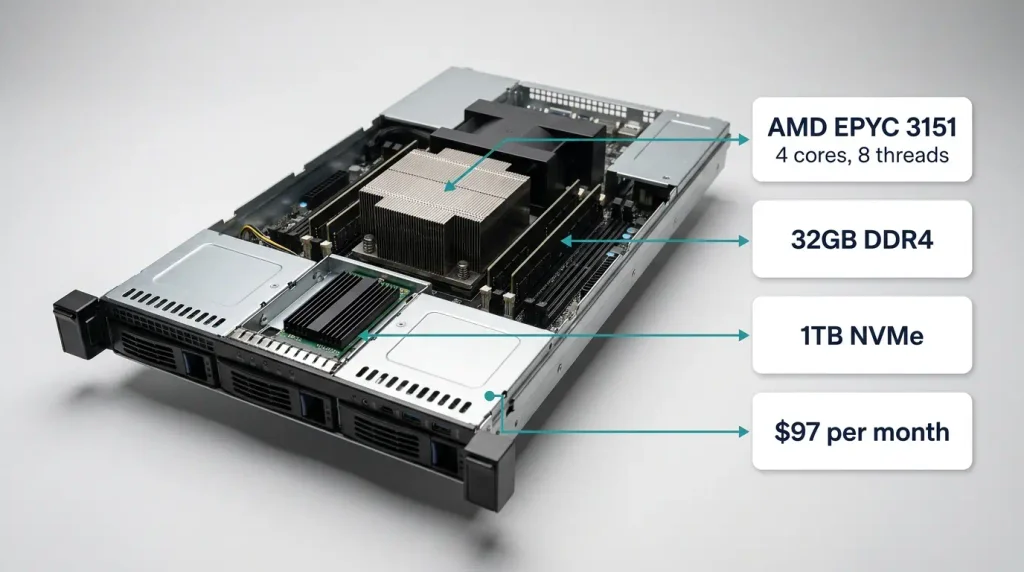
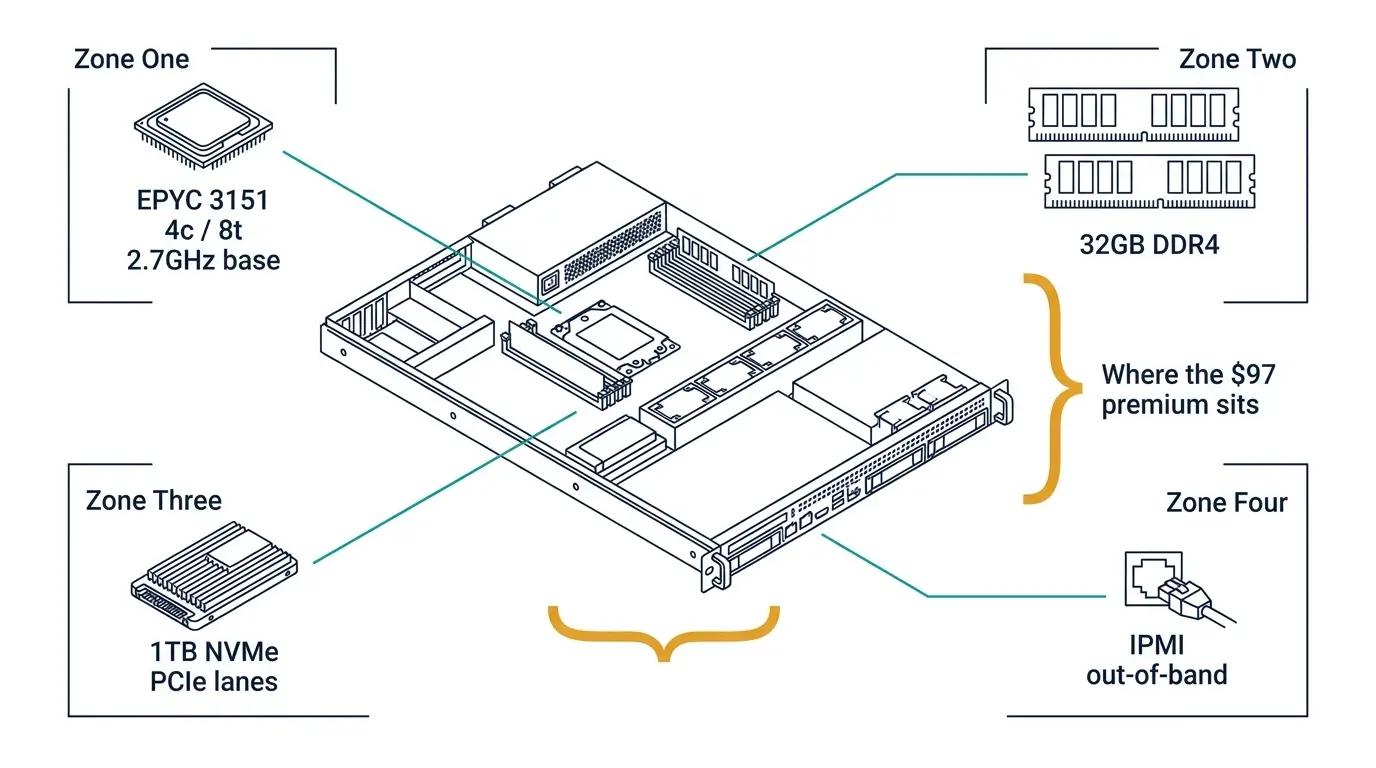
The EPYC 3151 belongs to AMD’s embedded server line, running 4 cores and 8 threads at a 2.7GHz base. That chip targets edge and storage workloads rather than heavy parallel compute, and the pairing makes sense once you see the 32GB of RAM and the NVMe drive attached to it.
NVMe = a storage protocol running over PCIe lanes instead of through a SATA controller, which cuts latency and raises IOPS. IOPS = input/output operations per second, the metric that decides how fast your database answers queries under concurrent load.
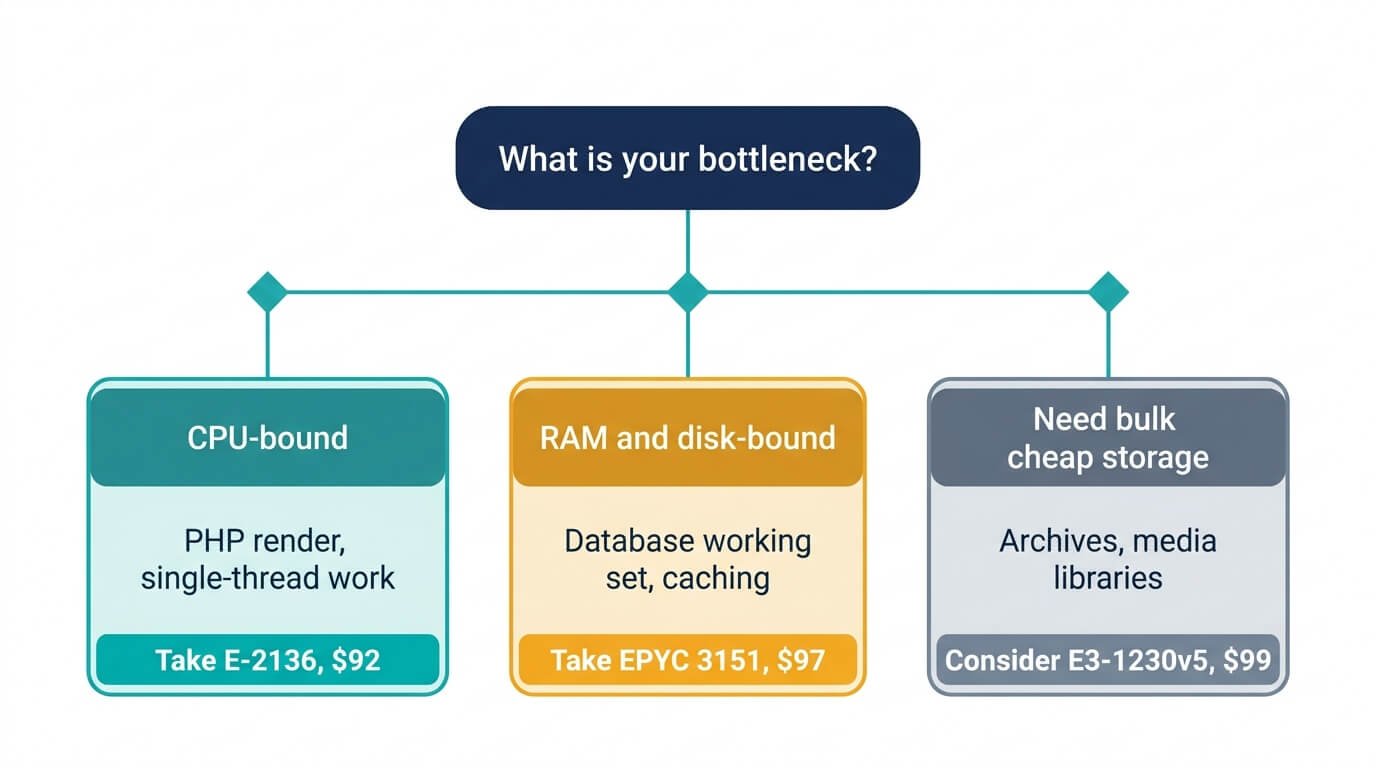
Which part of that spec sheet matters most for your workload? The answer depends on whether your bottleneck sits in CPU, memory, or disk, and the neighboring SKUs make that tradeoff visible.
The neighbors at the same price, and why they differ
1Gbits sells four plans within $21 of each other, and they are not interchangeable.
| Plan | Cores/Threads | RAM | Storage | Price | Cost per core | Cost per GB RAM |
|---|---|---|---|---|---|---|
| E-2136 | 6c / 12t | 16GB | 480GB SSD | $92 | $15.33 | $5.75 |
| EPYC 3151 | 4c / 8t | 32GB | 1TB NVMe | $97 | $24.25 | $3.03 |
| E3 1230v5+ | 4c / 8t | 8GB | 1TB SATA + 120GB SSD | $99 | $24.75 | $12.38 |
| E-2234 | 4c / 8t | 8GB | 1TB SATA + 120GB SSD | $113 | $28.25 | $14.13 |
Read that table twice before you order. The E-2136 at $92 delivers 50% more cores than the EPYC for $5 LESS, and the E-2234 at $113 gives you a quarter of the RAM of the $97 EPYC for $16 more.
Those numbers expose how 1Gbits prices this range. Older-generation Xeon E chips carry lower monthly costs because the hardware already depreciated, and the EPYC plan charges its premium for memory and NVMe rather than for cores.
Intel Xeon E processors post higher clock speeds than the embedded EPYC line, and 1Gbits builds most of its plans on Xeon E hardware for that reason. Single-thread performance drives PHP render time and MySQL query time, so a 6-core chip at 4GHz beats a 4-core chip at 2.7GHz on WordPress page loads.
“So the $97 plan is a bad deal?” No, and the storage column explains why.
Where the $97 tier earns its price
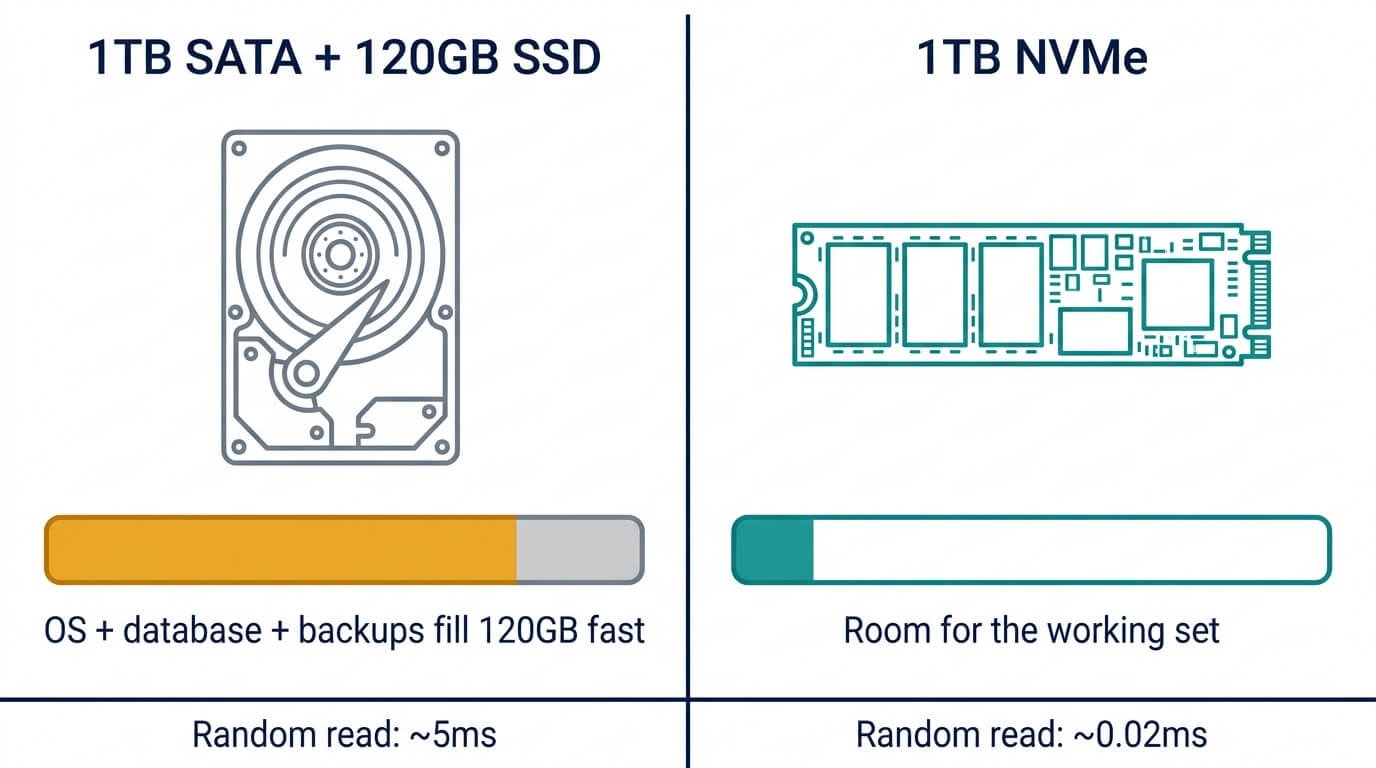
The EPYC plan ships 1TB of NVMe as its only drive. The $99 and $113 plans ship 1TB of spinning SATA disk with a 120GB SSD bolted on, and that 120GB fills fast once you install an OS, a database, and a few site backups.
Spinning disks resolve random reads in milliseconds while NVMe resolves them in microseconds. Your database does not care about sequential throughput, because it issues thousands of small random reads, and that access pattern punishes SATA drives brutally.
The 32GB of RAM matters for the same reason. More memory means MySQL or PostgreSQL caches a larger share of your working set in RAM, and cached queries never touch the disk at all. You get compounding benefit; big cache plus fast disk for the cache misses.
Ed. note: If your entire dataset fits inside 32GB of RAM, the EPYC plan at $97 will outperform the $113 plan on real page render times despite having the weaker CPU on paper.
Hardware value only settles once you compare it outside the 1Gbits catalog.
Honest comparison against OVH and Hetzner
OVH prices RISE-1 at $70 per month with a Xeon-E 2386G, 6 cores and 12 threads, 32GB of DDR4 ECC, and 2x512GB NVMe in soft RAID. That works out to $11.67 per core and $2.19 per gigabyte of RAM, and both figures beat the 1Gbits EPYC plan.
OVH also publishes a CPU benchmark score of 13976 for the 2386G on that same page, and they waive the $70 installation fee on any commitment of 12 months or longer. Hetzner starts dedicated servers at €59.00 per month, which lands below both.
I will state the conclusion plainly. On raw cost per core with a 12-month commitment, OVH RISE-1 beats the 1Gbits $97 plan, and pretending otherwise would make this review worthless to you.
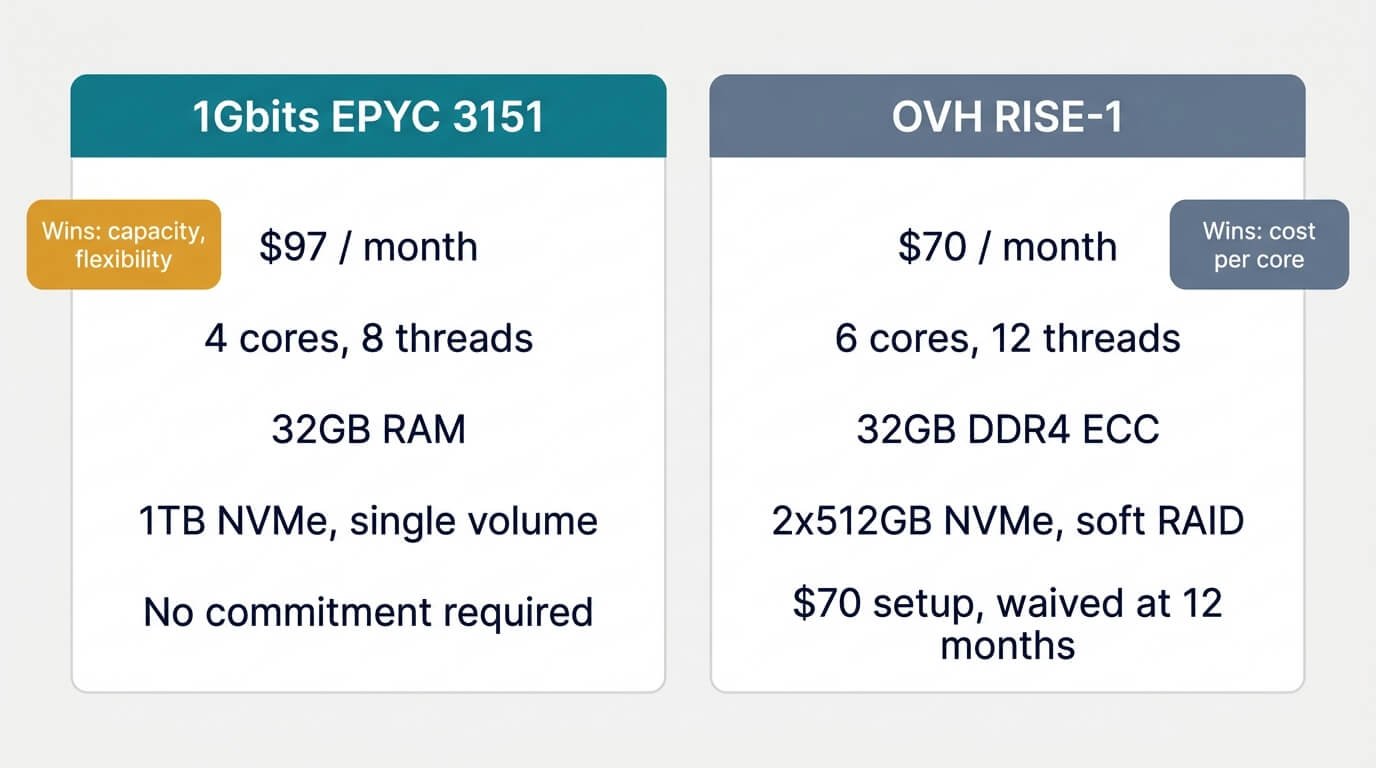
The 1Gbits advantages sit elsewhere. You get 1TB of NVMe in a single volume instead of 2x512GB in soft RAID, which gives you more usable capacity if you mirror the OVH pair. You pay month to month with no 12-month commitment required to avoid a setup fee. 1Gbits also accepts Bitcoin, USDT, ETH, and BNB, and operates across more than 20 regions spanning North America, Europe, and Asia.
Do those advantages justify $27 more per month? For a US or Asian audience needing a specific city, or for a team that refuses a year-long commitment, yes. For a European project willing to commit 12 months, Hetzner or OVH wins on price.
What comes included, and what does not
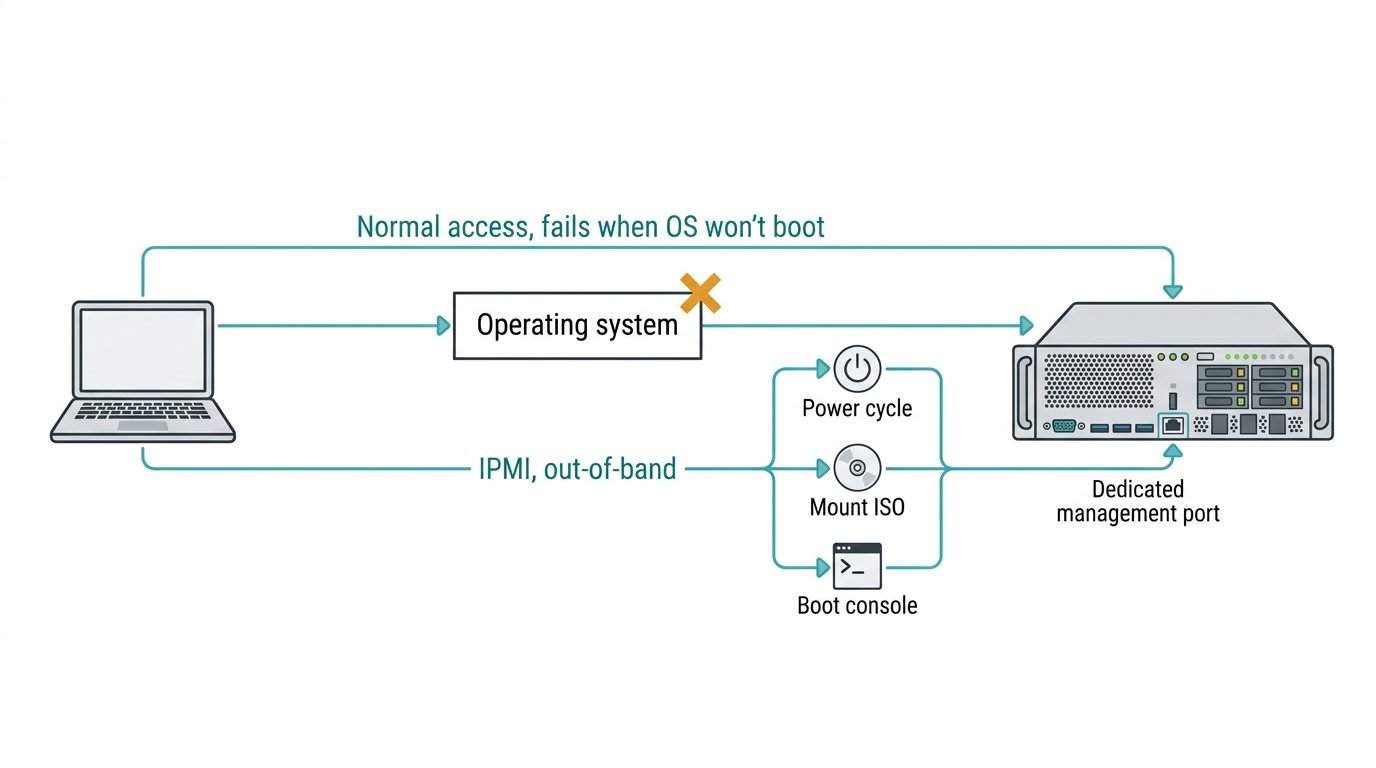
IPMI arrives with the server. IPMI = a management interface reaching your hardware independently of the installed OS, letting you power cycle the box, mount an ISO, and watch the boot console when the OS refuses to start. That access removes support tickets from your recovery path during a broken kernel update.
You install any operating system you want, because unmanaged bare metal hands you root and steps back. 1Gbits runs 24/7 support through live chat and dashboard tickets, and the same FAQ documents a 99.9% uptime guarantee plus a 7-day money-back guarantee. The company has operated since 2014.
Servers sit in Tier-III data centers, and Tier-III means N+1 redundancy on power and cooling with concurrent maintainability, so technicians replace a failed component without cutting power to your rack.
Two things do not come included. You get no managed control plane, no autoscaling, and no hourly billing. Provisioning also takes business days rather than minutes, because 1Gbits configures hardware to your ordered specification instead of allocating from an automated pool.
Who should buy the $97 tier
Buy it if you run a database-heavy self-hosted application, want 32GB of RAM and NVMe at under $100, and refuse a 12-month commitment.
Buy the $92 E-2136 instead if your workload is CPU-bound, because you get 6 cores and 12 threads with a higher clock for $5 less. Skip the $99 and $113 plans entirely unless you specifically need 1TB of cheap spinning storage, because 8GB of RAM constrains any modern database workload.
Look at OVH or Hetzner if your users sit in Europe and you accept a year commitment. Look at a VPS if you need capacity today, since 1Gbits VPS plans start at $15 per month and provision far faster than bare metal.
Frequently asked questions
Verdict
This 1Gbits bare metal review lands on a narrow recommendation. The $97 EPYC 3151 plan makes sense for memory-hungry and disk-hungry workloads that need 32GB and NVMe without a year-long contract, and it loses to OVH on pure cost per core.
Run your own numbers against your actual bottleneck. Compare the full configuration list and use the 7-day window to benchmark before the second invoice arrives.
👉 Aκολούθησέ με στο Facebook και ενεργοποίησε τις ειδοποιήσεις για να λαμβάνεις τα νέα άρθρα μου.